
April 2021: Distracted Driving Awareness Month

April is National Distracted Driving Awareness Month. This is a great time to reflect on our driving behaviors and pledge to make good choices in the car, both for safety and to be good role models for our passengers. While phones are a common distraction, adjusting the radio, picking up dropped toys, putting on makeup, and even eating and drinking takes your attention away from the road.
Not only does driving distraction-free help prevent car crashes, but it shows the children and teens in the vehicle that you take safety seriously. Show your children how safe driving is done by following these tips:
Pull over and park your car in a safe location if you need to send, read, or respond to a text.
Give your passenger the phone. The “designated texter” can respond to texts, calls, and choose the music.
Checking your phone can be a hard habit to break. If you’re struggling to resist texting or scrolling through apps while driving, try putting the phone out of reach in the trunk or back seat for safe keeping until you arrive at your destination.
Remind children and passengers that you need to pay full attention to driving. If you need to make an adjustment to the radio, or deal with food, drinks, or dropped toys mid-trip, pull over.
Find more resources on distracted driving in our toolkit and on NHTSA’s webpage.
Toolkit Outreach Week: April 19th – 25th
Just in time for spring, we are hosting an outreach week April 19th – 25th, 2021 using our upcoming toolkit on lawn mower safety. Lawn mowers send thousands of children to the emergency department every year with serious cuts, burns, and amputations, so it’s important to keep young children away from lawn mowers when they are being used. Our toolkit materials will be available soon, so keep an eye on your inbox for our announcement.
One Year of Newsletters
This month we celebrate one full year of Prevent Child Injury monthly newsletters! We appreciate your support throughout the past year and are looking forward to another year of newsletters. If you would like to submit an event or announcement to be featured in one of our newsletters, please send an email to info@preventchildinjury.org.
Take Action
Every month, we are promoting a new action that each family can take to keep their children safer. This month, we want every family to save the Just Drive pledge from National Safety Council. Make the roads a little safer for you, your family, and other drivers by pledging to drive distraction-free. Take the pledge here.
Follow along every month for a new action, and share with us how you're preventing child injury in your home!
Coming Up
On Our Twitter Calendar
March 29 - April 4: National Youth Sports Safety Month
April 5 - 11: National Window Safety Week; National Public Health Week; World Health Day
April 12 - 18: Distracted Driving Awareness Month
April 19 - 25: Outreach Week: Lawn Mower Safety
April 26 - May 2: National Playground Safety Week
Events
Twitter Chat: Distracted Driving Awareness Month
Hosted by: National Safety Council
Date/Time: April 14th, 2021 from 2 - 3PM EST
Participate in the Distracted Driving Awareness Month Twitter chat at 2 p.m. EST on April 14th. Join NSC and others on Twitter to answer questions about distracted driving, ask your own questions about roadway safety and engage with other organizations focused on keeping their workers safe on the road. Use the hashtag: #JustDrive21 in all of your posts during the chat.

Trainings: Media 101, Media 201, Social Media
Hosted by: Center for Injury Research and Policy at Nationwide Children’s Hospital
Date/Time: Multiple dates available for each training
The Center for Injury Research and Policy at Nationwide Children’s Hospital is hosting three online workshops for public health professionals over the next few months. Trainings include: Media 101: Beginner’s Guide to Working with the Media, Media 201: Mastering Your Messaging and Owning Your Interview, and Social Media: Public Health in the Digital Age. Each training is a one-day, four-hour online workshop. Discounts are available for attending multiple trainings. CHES credits available for some trainings. Click here for details and to register. Space is limited, so we encourage you to register now. Please email Laura.Dattner@NationwideChildrens.org with any questions.
Archived
March 2021: National Poison Prevention Week
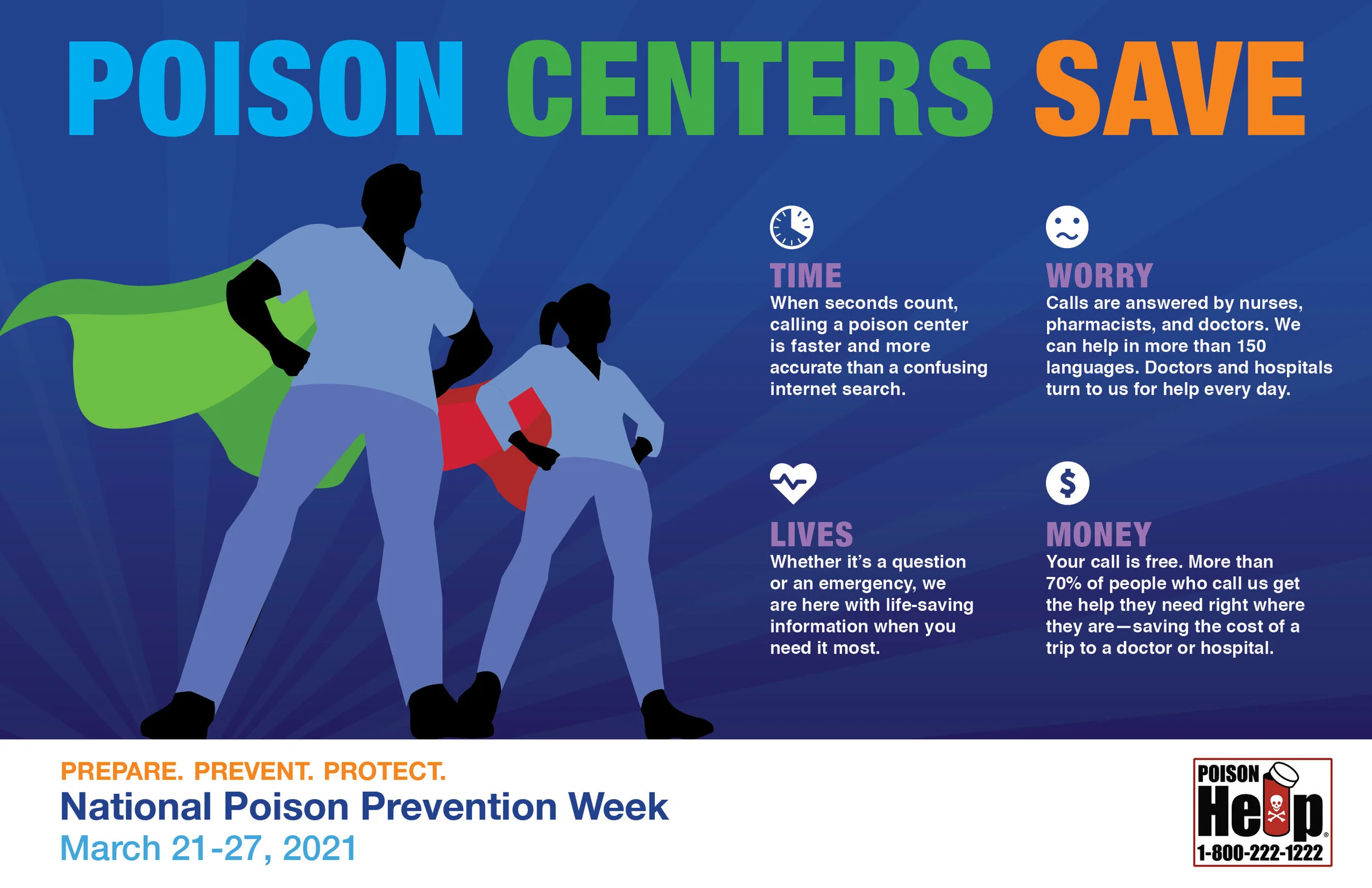
Every day, more than 300 children in the United States are treated in an emergency department for poisoning. Household poisoning risks include everything from common household cleaners and chemicals to ones families might not think about, like hand sanitizer and mistakes with medications. National Poison Prevention Week (March 21-27) is hosted every year to raise awareness for poison control centers and the Poison Help hotline (1-800-222-1222) and to remind parents and caregivers about the risks of poisonings. Participate in National Poison Prevention Week this year by starting with these resources:
Poison Prevention Week websites:
Prevent Child Injury toolkits:
Other poison prevention resources from our trusted partners:
We Need Your Help
Help us serve you better by taking a moment to fill out this short form. Individuals who fill out the form will be entered to win a Prevent Child Injury notebook. Thank you!

Take Action
Every month, we are promoting a new action that each family can take to keep their children safer. This month, we want every family to save the Poison Help Hotline number in cell phones and post it visibly near home phones: 1-800-222-1222. If you suspect your child has ingested or been exposed to a poison, call the Poison Help Hotline right away. The Poison Help Hotline specialists answer questions and provide advice free of charge.
Follow along every month for a new action, and share with us how you're preventing child injury in your home!
Coming Up
On Our Twitter Calendar
March 1 - 7: National Athletic Training Month
March 8 -14: Brain Injury Awareness Month
March 15 - 21: National Cheerleading Safety Month
March 22 - 28: National Poison Prevention Week
Events
Webinar: Farm Safety for Children and Youth: Risks and Rewards
Hosted by: Children’s Safety Network
Date/Time: March 4th, 2021 from 3 - 4PM EST
Marsha Salzwedel of the National Children’s Center for Rural and Agricultural Health and Safety will outline the risks and benefits of farm work, share evidence-based/informed prevention strategies, challenges, and resources. Amy Rademaker of Carle Hospital in Illinois, will share her experiences working with farmers and their families through the Progressive Ag Safety Day Program. Register for the webinar here.
Webinar: Marijuana and Teenage Driving Risks in Illinois
Hosted by: Midwest Injury Prevention Alliance & Dale O. Ritzel, PhD, FAASE
Date/Time: Wednesday March 10, 2021 from 2pm - 3pm EST
The Midwest Injury Prevention Alliance will be welcoming Dale O. Ritzel, PhD, FAASE, Professor of Public Health and Director Emeritus, Safety Center, School of Human Sciences, Southern Illinois University Carbondale. Dr. Ritzel will speak about marijuana laws and vehicle crash rates, discuss the use of marijuana by teenagers in Illinois and other states, and identify marijuana effects on the body and teenage brain and likely effects on teenage driving. Click here to reserve your spot to attend the webinar.
Virtual Meeting: SAVIR Injury & Violence Prevention Grand Rounds
Hosted by: Society for Advancement of Violence and Injury Research
Date/Time: Thursday, March 11, 2021, from 4 - 5:30 pm EST
The Grand Rounds series “fosters improved cohesion and connections among participants of the injury and violence prevention research community with practitioners and policymakers, focuses the attention of the public health community on important injury and public health issues that affect our community, and strengthens capacities to promote and protect health by sharing knowledge about important public health problems and promising opportunities and efforts to address those problems in our area.” Register here.
Trainings: Media 101, Media 201, Social Media
Hosted by: Center for Injury Research and Policy at Nationwide Children’s Hospital
Date/Time: Multiple dates available for each training
The Center for Injury Research and Policy at Nationwide Children’s Hospital is hosting three online workshops for public health professionals over the next few months. Trainings include: Media 101: Beginner’s Guide to Working with the Media, Media 201: Mastering Your Messaging and Owning Your Interview, and Social Media: Public Health in the Digital Age. Each training is a one-day, four-hour online workshop. Discounts are available for attending multiple trainings. CHES credits available for some trainings. Click here for details and to register. Space is limited, so we encourage you to register now. Please email Laura.Dattner@NationwideChildrens.org with any questions.
Archived
February 2021: Burn Awareness & Prevention
Over 300 children are treated in emergency departments for burn-related injuries every day in the United States. Children can experience burns from everyday things in the home, like food, bathwater, and electrical cords. Keep these tips in mind to help prevent burns:
Keep hot items out of reach. Never leave hot devices, like clothing irons and hair straighteners, unattended while plugged in. When not in use, store these items unplugged and out of reach.
Take caution with hot food and drinks. Don't cook, drink, or carry hot beverages or food while holding a child. Use travel mugs or cups with tight-fitting lids for coffee and other hot drinks, even when at home. Turn the handles of pots and pans toward the rear of the stove and use back burners when possible. Never leave the stove unattended when cooking.
Test bathwater temperature. Test the water with your wrist or elbow to make sure that the water feels warm, not hot, before placing a child in the tub. Set the thermostat on your hot water heater to 120 F (48.9 C).
Set up a child safety fencing around the fireplace. Child safety fencing is designed to keep children a safe distance from the fire and hot fireplace screens, which can reach dangerously high temperatures and can take over an hour to cool down.
Check electrical cords. Replace frayed, broken or worn electrical cords to help prevent electrical burns.
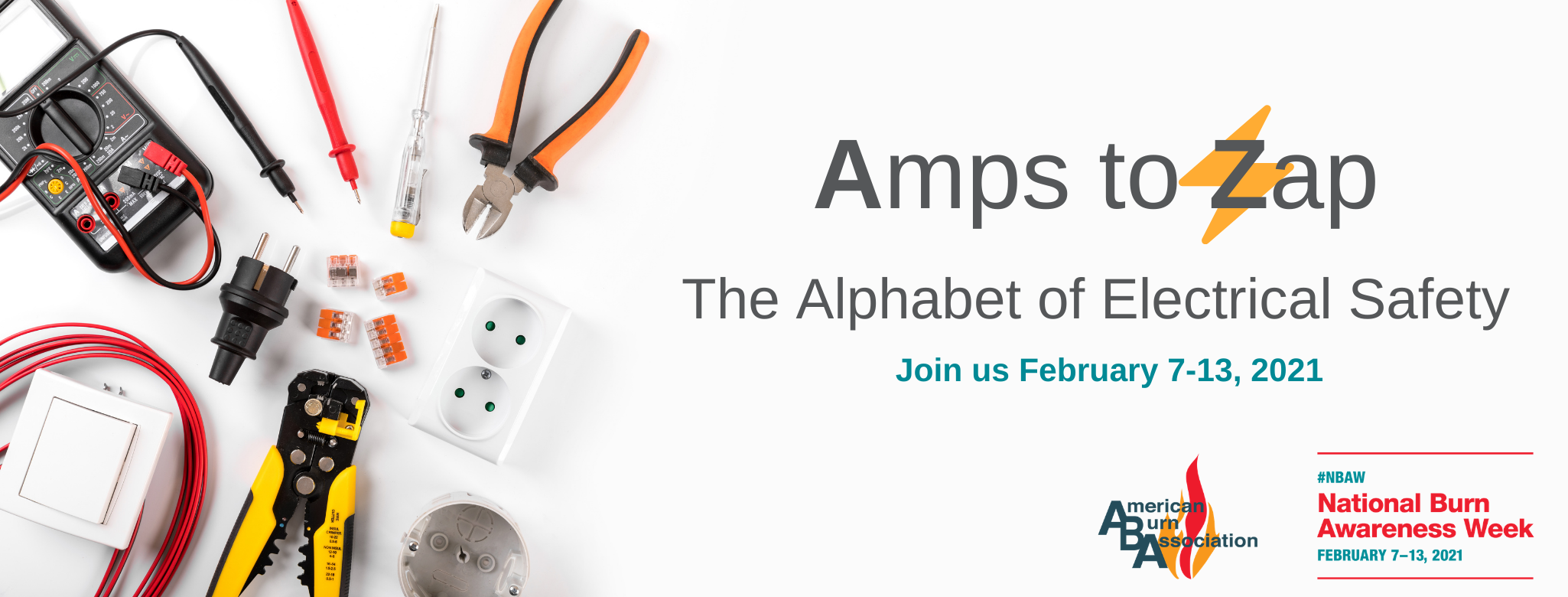
National Burn Awareness Week is February 7th - 14th, 2021. This annual event is a great opportunity for burn care organizations, burn survivor support groups, public safety, and injury prevention professionals to increase awareness of the frequency and causes of burn injury to the parents and caregivers they serve. The theme for 2021 is Electrical Safety from Amps to Zap (A to Z)! Learn more about the awareness week and what you can do to support the event here.
Toolkit Outreach Week: Home Exercise Equipment Safety
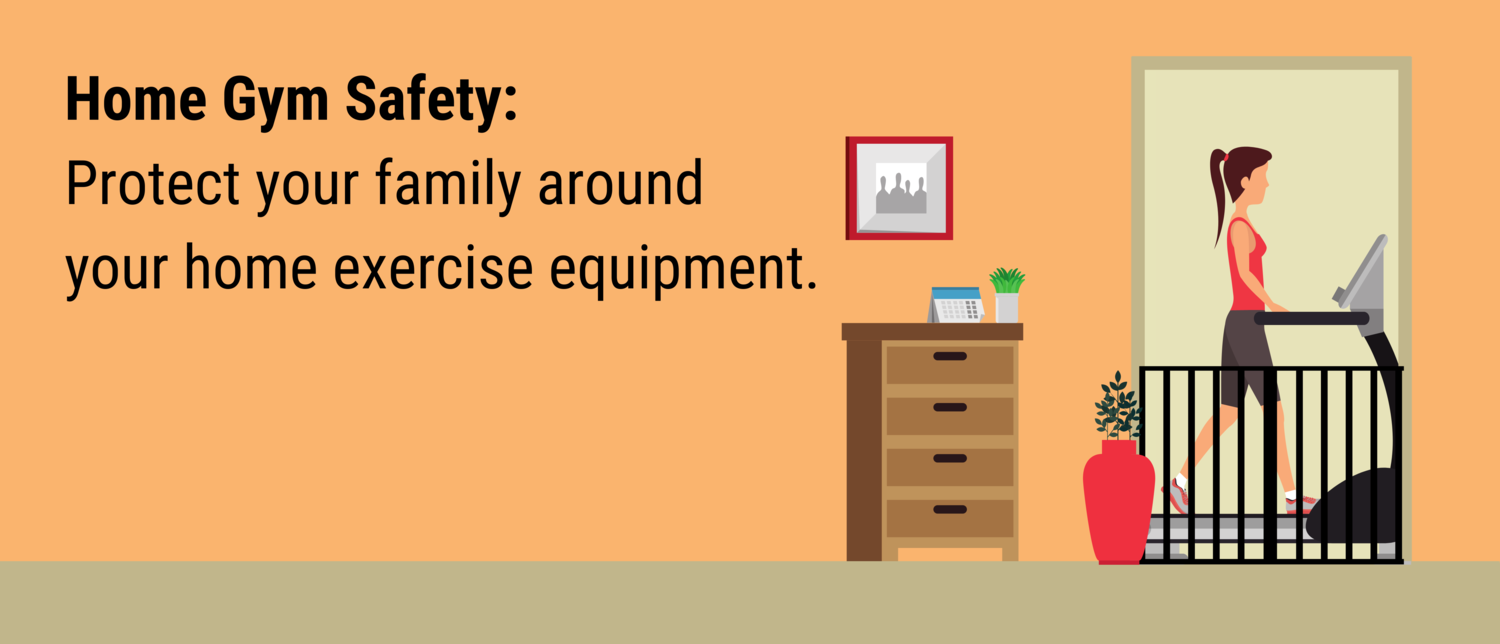
Join us for our outreach week February 8th - 14th using our toolkit on home exercise equipment safety. Treadmills, stationary bikes, and weight sets might be just what you need to reach your fitness goals, but for kids, they can be hazardous. Review the toolkit and add home exercise equipment safety to your outreach plans.
Survey: Webinar Series
We are planning a webinar series and would like input from our membership. Are there specific topics you’d like to learn more about? Any individuals or organizations you would like to present? Please share your opinions and preferences with us in our survey.
Take Action
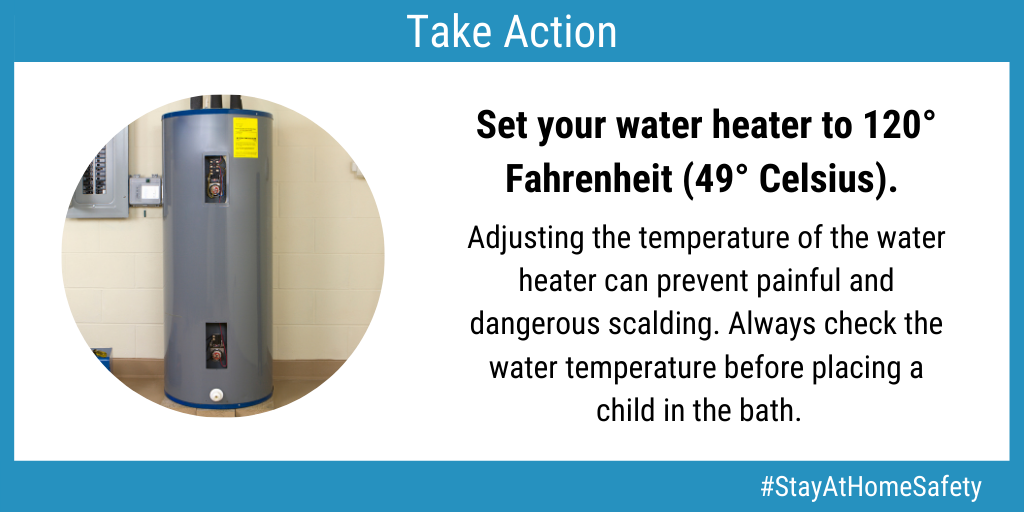
Every month, we are promoting a new action that each family can take to keep their children safer while social distancing. This month, we want every family to set their water heaters to 120 degrees F (49 degrees C) to prevent painful and dangerous scalds. Always check the temperature of bathwater to make sure it’s not too hot before placing a child in the water.
Follow along every month for a new action, and share with us how you're preventing child injury in your home!
Coming Up
On Our Twitter Calendar
Feb. 1 - 7: TV Tip-Overs
Feb. 8 - 14: Home Exercise Equipment Toolkit Outreach Week
Feb. 15 - 21: Burn Awareness Week
Feb. 22 - 28: Button Batteries
Events
Enter the American Burn Association’s Burn Prevention Poster Contest. “Posters may address contact burns, scalds, any single burn or fire prevention problem, a specific population, or multiple etiologies. Posters will be evaluated according to originality of the idea, creativity, quality of the verbal and graphic message, the immediate clarity and positive tone of the message the poster conveys, as well as composition, and other elements of design.” Learn more about the contest and submit your poster here. Deadline for entries is February 15th, 2021.
Injury Prevention Research Center at Emory (IPRCE) will co-sponsor a workshop for "Practical Evaluation Skills for Public Health Practitioners" with Region IV Public Health Training Center on February 23rd, 2021 from 8:45am-12pm EST. This workshop is designed for people who are familiar with the value of evaluation and are looking to hone their practical evaluation skills. This course has limited capacity and will be offered to IPRCE partners and affiliates only. Register here for the event.
Archived
January 2021: Sledding Safety

Winter is here and many families are looking for ways to get outside. Sledding is a popular and fun activity that children of all ages enjoy, but every year, thousands of children end up going to emergency departments across the U.S. for sledding injuries like concussions and broken bones. Luckily, all it takes is a little preparation and planning to prevent many of these injuries. Keep children safer on the hill this year by sharing these tips:
Equipment Check
Helmet: Make sure your child has a helmet they can wear. A snow sports helmet works best, but if your child doesn’t have one, a bicycle helmet is the next best choice. If your child needs to wear a hat to keep warm, make sure to readjust their helmet.
Sled: Buy a sled that can be steered, not snow tubes or round disks. Check for and fix sleds with broken or missing parts. Follow manufacturer guidelines for the number of passengers the sled can safely hold.
Environment Check
Hill: Pick the right hill before the snow falls. Look for hills that do not have any trees, fences, posts, or other objects children could run into. Make sure there is plenty of space for the sled to come safely to a stop at the bottom of the hill, away from roads and water (ponds, rivers, etc.).
Parent Present: Join your child at the sledding hill. Adults see dangers that children might not see and can quickly help if an injury does happen.
On The Hill
Sled Basics: Show your child how to sit feet-first and steer the sled. Practice on a small hill before moving to larger hills.
Space: Teach your child how to stay out of the path of other sledders.
Read more about sledding safety and check out our toolkit (including some new resources!).
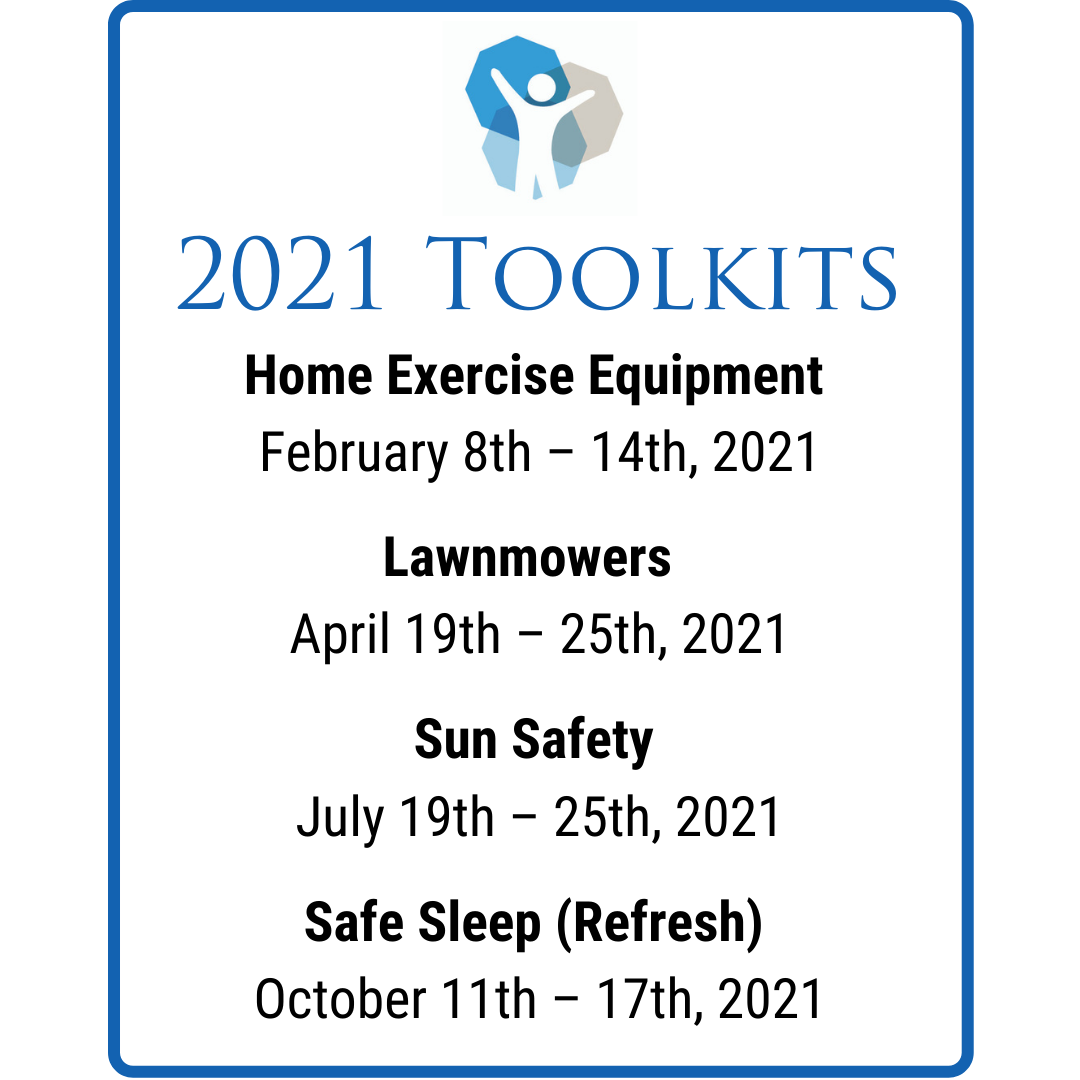
2021 Activities
We are excited to announce our 2021 toolkit topics and outreach week dates:
Home Exercise Equipment Safety: February 8 – 14
Lawnmower Safety: April 19 – 25
Sun Safety: July 19 – 25
Safe Sleep (Toolkit Refresh): October 11 – 17
In case you missed it, we recently released our 2021 Social Media Calendar. Download the calendar here.
Take Action
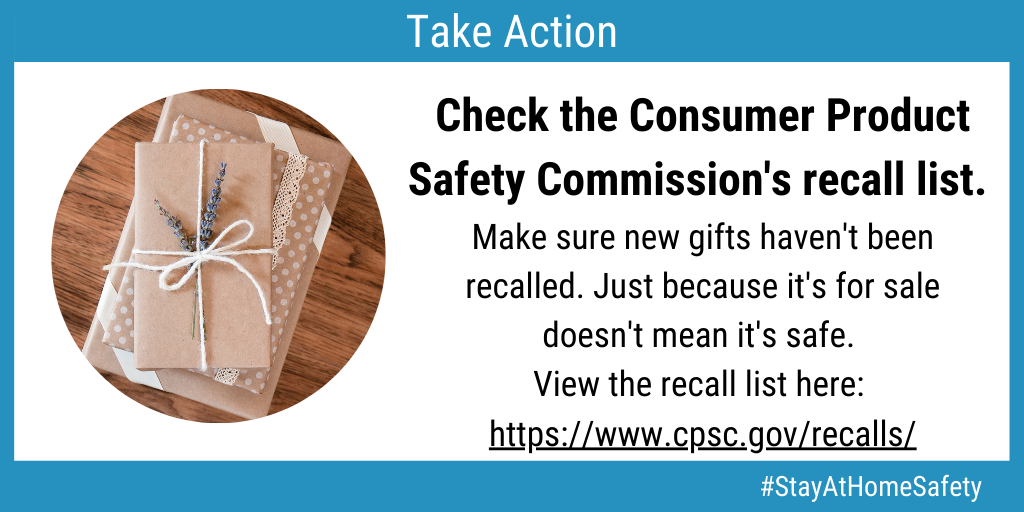
Every month, we are promoting a new action that each family can take to keep their children safer. This month, we want every family to check the United States Consumer Product Safety Commission’s recall list to see if new gifts have been recalled. Just because it’s for sale, doesn't mean it’s safe. View the CPSC’s list of recalled products here: https://www.cpsc.gov/Recalls/
Follow along every month for a new action, and share with us how you're preventing child injury in your home!
Coming Up
On Our Twitter Calendar
Jan. 4 - 10: New Year’s Resolutions: Resolve to be Safe
Jan. 11 - 17: Frostbite/Winter Exposure Safety
Jan. 18 - 24: National Radon Action Month/Carbon Monoxide Safety
Jan. 25 - 31: National Winter Sports TBI Awareness Month
Events
Attend the webinar, “Partnering for Child Safety: Fatality Review Teams and State Title V Programs,” taking place on Thursday, January 14th from 2 - 3PM EST. Abby Collier of the National Center for Fatality Review and Prevention will describe the fatality review process, with a focus on data collection, and provide examples of how fatality review supports Title V work. Additionally, written guidance on how fatality review can support national performance measures on adolescent mental health, including youth suicide, infant safe sleep and smoking during pregnancy will be highlighted and distributed. Karen Nash of the Children’s Health Alliance of Wisconsin will share her agency’s innovative partnership between Child Death Review (CDR) and Title V. Wisconsin is disseminating CDR recommendations to appropriate, parallel Title V programs working with target populations. Register (for free) here.
Archived
December 2020: Safe Toys & Gifts

One of the most exciting traditions of the winter holidays is giving gifts, and everyone loves seeing a child’s eyes light up when they receive the perfect gift. However, the U.S. Consumer Product Safety Commission reported that over 220,000 toy-related injuries were treated in emergency departments in 2019 — due to ingestions, broken bones, cuts, and more. Share these toy shopping tips with the families you serve to keep this year's holiday celebrations safer:
Avoid magnet sets. High-powered magnets (or rare earth magnets) can cause life-threatening injuries if swallowed. When a child swallows two or more high-powered magnets or one magnet and a metal object, they can attract each other through layers of tissue, causing severe damage. Learn more about high-powered magnets in our toolkit.
Make sure button batteries are secure. Found in many toys, “button” batteries are small, coin-sized batteries that can cause serious injury, including death, in as little as 2 hours. Make sure that toys that contain button batteries have a secure battery compartment that requires a tool (like a screwdriver) to open.
Buy a helmet. Thinking of buying a bicycle, skateboard, or scooter? Please buy a helmet to go with it. All ride-on toys should be purchased with the proper safety equipment, like helmets and knee/elbow pads.
Read the label. Always read the labels on the packaging to make sure the toy is age-appropriate and nontoxic, and before gifting, read the instructions so that you can show the child how to use the toy properly.
Listen for loud noise. Not only can loud noises be frightening to a child, they can permanently damage a child’s hearing. If the toy is too loud for you, it is too loud for a child. Before gifting, remove the batteries or reconsider the toy altogether.
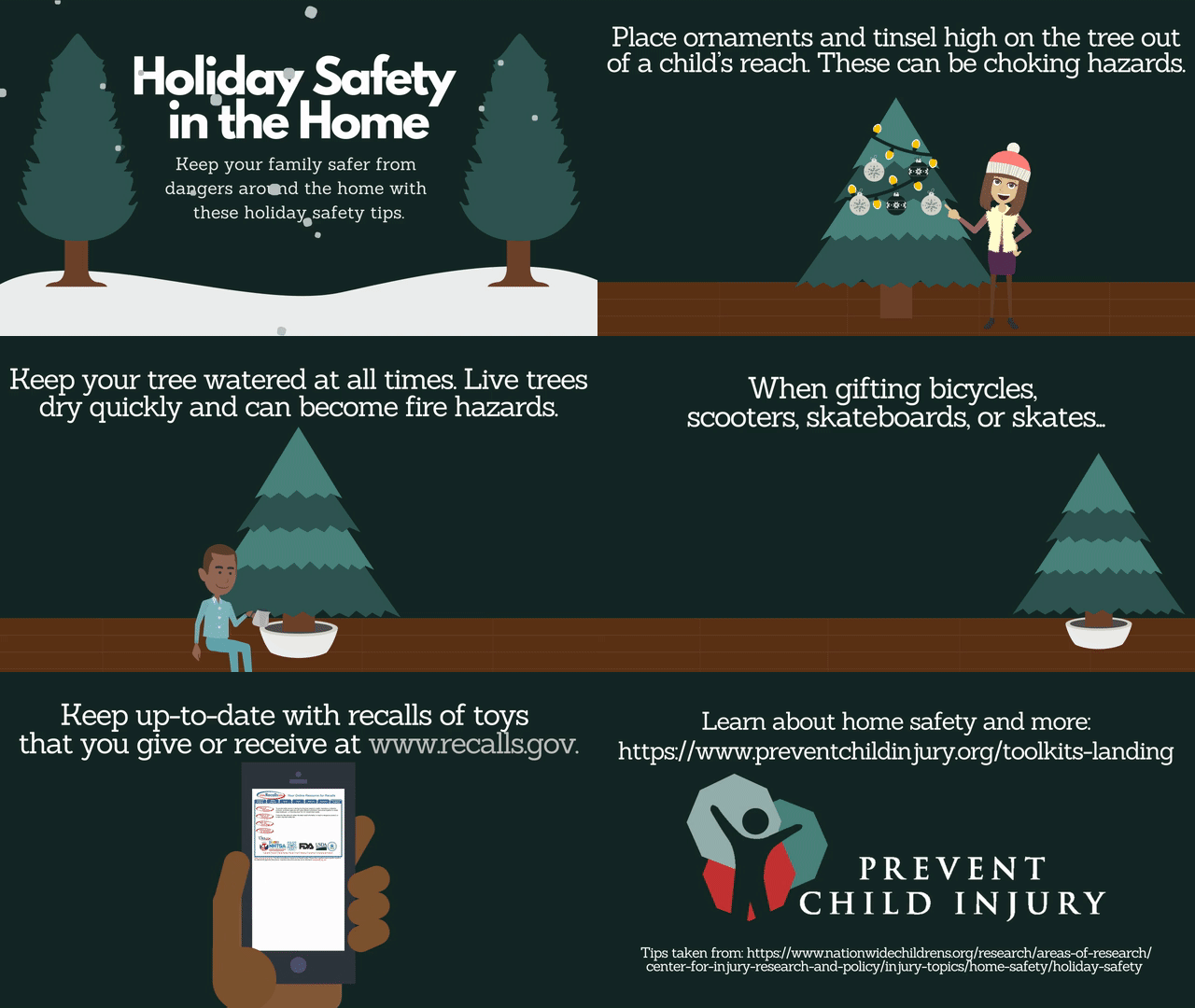
New GIF: Holiday Safety Tips
We are excited to share our new Holiday Safety Tips GIF! Click on the link below to download and share.
Take Action
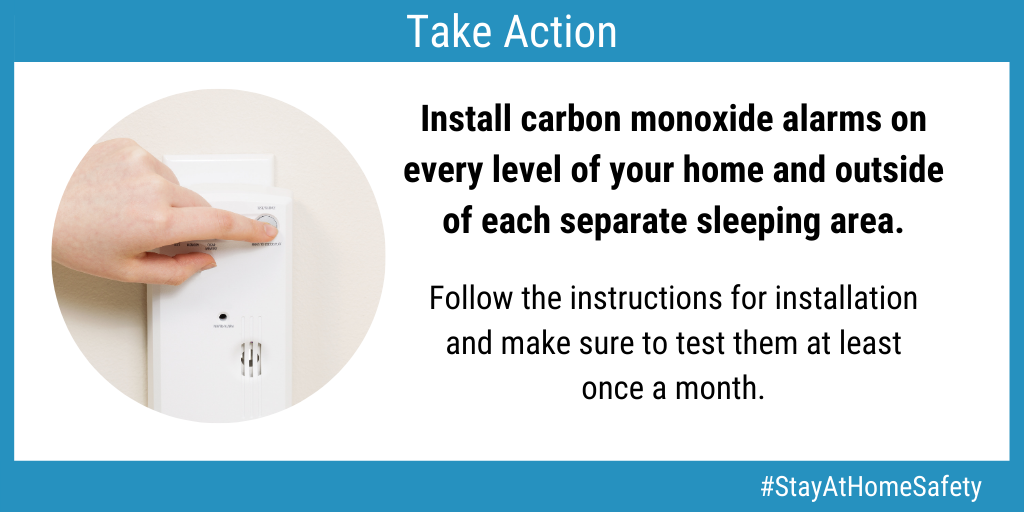
Every month, we are promoting a new action that each family can take to keep their children safer while social distancing. This month, we want every family to install carbon monoxide alarms on every level of their home and outside of each separate sleeping area. The risk of carbon monoxide poisoning increases during the winter, and carbon monoxide alarms are the only way to know if there are dangerous levels of carbon monoxide in the home.
Follow along every month for a new action, and share with us how you're preventing child injury in your home!
Coming Up
On Our Twitter Calendar
Nov. 30 - Dec. 6: Holiday Decoration Safety
Dec. 7 - 13: Safe Toys and Gifts Month
Dec. 14 - 20: Sledding Safety
Dec. 21 - 27: Winter Travel
Dec. 28 - 31: Recap Major Safety Stories of 2020
Events
Are you planning to apply to the Safe Routes to Parks Activating Communities program? Do you have questions? Join the Safe Routes Partnership for an in-depth information session on December 3, 2020 from 3:00 pm - 4:00 pm EST. The Healthy Parks and Places Manager will review eligibility requirements, what is included in the grant program, and what will be expected from the organizations that are awarded. There will also be time to answer your specific questions that go beyond the application FAQs. Register for the session.
Attend the webinar “Alcohol Use and Partner Violence Among Adolescents and Emerging Adults,” hosted by the Maryland Department of Health Center for Injury & Sexual Assault Prevention and the Great Lakes & Mid-Atlantic Violence and Injury Prevention Regional Network. The webinar is taking place on December 3, 2020 from 3pm - 4pm EST. To RSVP and get instructions to join the webinar, click here.
Attend the upcoming webinar "On the Road to Zero: Child Passenger Safety" hosted by the National Safety Council on Tuesday, December 8th, 2020 at 2pm EST. This webinar will explore child passenger safety, including current trainings, trends and research around the topic. Attendees of this webinar will learn about opportunities to improve child passenger safety both systematically and in their own communities. Register here.
Attend the upcoming Midwest Injury Prevention Alliance (MIPA) Virtual Summit being help virtually on December 9th, 2020, from 8:00 am - 12:45 pm CST. This year’s theme—Keeping a 20/20 Focus During Challenging Times—will cover important topics that will inspire, instruct and illustrate the power of partnerships, the passion of programs, and the practice of policy in changing the landscape of injury and violence in each of our states. Register for free here.
Archived
November 2020: Cooking Safety

Winter holidays are quickly approaching! Many families celebrate by spending hours in the kitchen preparing meals. However, the kitchen can be a dangerous place for children, with hot ovens, boiling soups, and sharp knives. A few simple prevention tips can go a long way in keeping everyone safer in the kitchen.
Keep young children out of the kitchen if possible. Activities like puzzles, books, holiday movies, and recipe prep (that can be done outside of the kitchen) are great ways to keep the kitchen less crowded and the children busy. If your child is eager to help out in the kitchen, read over this guide from National Fire Protection Association for age-appropriate activities your child can do.
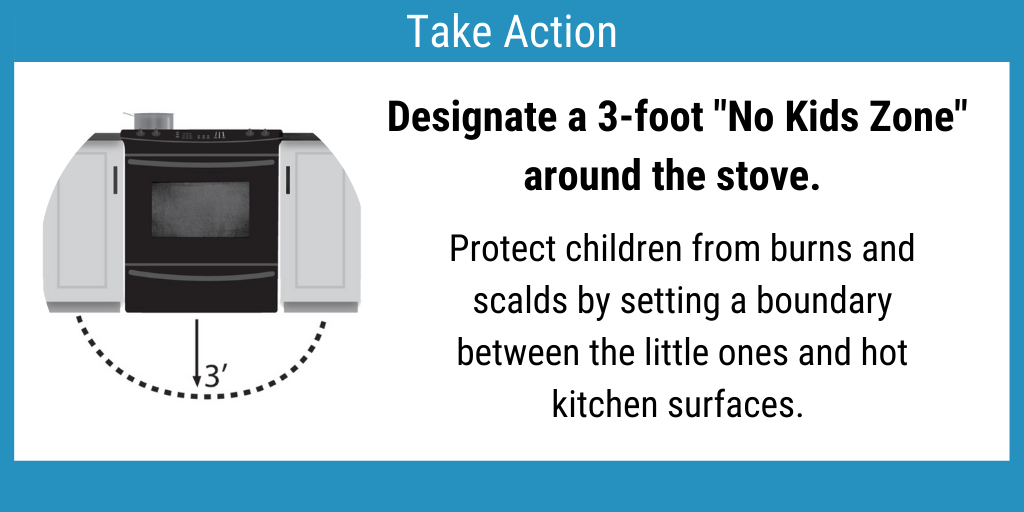
Use the back burners of your stove, turn pot handles away from the edge, and mark a 3-foot “kids-free zone” around the stove. Using the burners towards the back of the stove with the pot handles turned away from the edge can prevent young children from touching a hot surface or pulling down a hot pan. Outlining a “kids-free zone” shows children the area is off-limits.
Keep appliance cords away from counter edges and out of reach of children. To keep children from pulling appliances down on themselves, tuck away the cords of appliances like blenders, slow cookers, and food processors so that they aren’t close to the edge or dangling off the countertop.
Know how to put out kitchen fires. The winter holidays are the peak days for cooking fires. Learn more about putting out cooking fires from the National Fire Protection Association.
Archived
Toolkit Outreach Week: November 16th - 26th
We are hosting an outreach week November 16th – 26th using our updated toolkit on liquid nicotine. Each year, U.S. poison control centers receive thousands of calls about young children who have been exposed to vaping-related products. To protect children from liquid nicotine poisoning, safe handling and storage of vaping-related products in the home is critical. Our toolkit materials will be available soon, so keep an eye on your inbox for our announcement.
Take Action
Every month, we are promoting a new action that each family can take to keep their children safer. This month, we want every family to designate a 3-foot “No Kids Zone” around the stove. Keep children safer in the kitchen by marking a clear boundary around the hot surfaces and liquids on the stove and in the oven.
Follow along every month for a new action, and share with us how you're preventing child injury in your home!
2021 Toolkits Survey

Do you have a topic you would like us to create a toolkit on? Are there materials that we can create that can help you and your organization? We are planning our toolkit topics for the 2021 calendar year and would love to hear from you. Tell us your ideas and preferences here.
Coming Up
On Our Twitter Calendar
Nov. 2 - 8: Winter Safety Awareness Month
Nov. 9 - 15: Stair Safety
Nov. 16 - 22: Toolkit Outreach Week: Vaping
Nov. 23 - Nov. 29: Thanksgiving Safety
Events
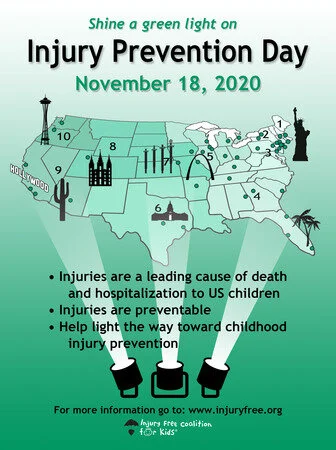
To highlight the significance of injuries to children as well as the importance of injury prevention, the Injury Free Coalition for Kids™ will launch the country’s first “National Injury Prevention Day” on Wednesday, November 18. They invite your institution to join the multi-center, multi-city effort to work with your city and their landmarks in this important event. The event includes a Twitter chat that is set for 1–2PM EST on Wednesday, November 18th, using the hashtag #BeInjuryFree. Read more about how you can participate in National Injury Prevention Day here.
October 2020: Halloween & COVID-19

Halloween is just around the corner! Because the Centers for Disease Control and Prevention and the American Academy of Pediatrics do not recommend traditional trick-or-treating this year, families are looking at their options on how to celebrate Halloween safely. Families are getting creative and finding unique ways to get in the spooky spirit without going door-to-door. Even though Halloween looks different this year, there are plenty of ways that families can stay safe and have fun.
Alternative Activities for Halloween
Some families may still choose to participate in trick-or-treating. On top of the additional precautions they will need to take to prevent the spread of COVID-19, the traditional hazards, such as pedestrian safety, costumes, and limited visibility from costume masks still apply.
Trick-or-Treating Safety
2021 Toolkits Survey
Do you have a topic you would like us to create a toolkit on? Are there materials that we can create that can help you and your organization? We are planning our toolkit topics for the 2021 calendar year and would love to hear from you. Tell us your ideas and preferences here.
Take Action
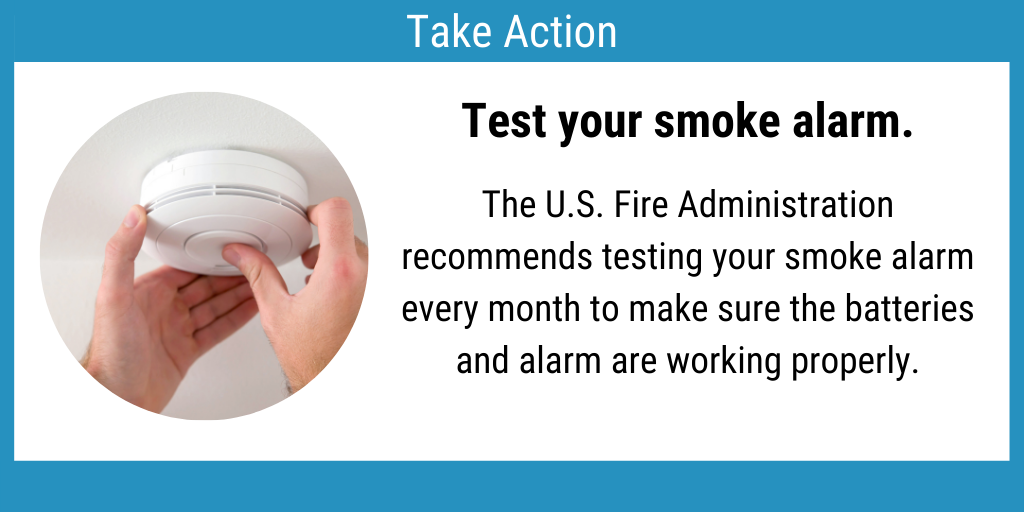
Every month, we are promoting a new action that each family can take to keep their children safer. This month, we want every family to test the smoke alarms in their home. The U.S. Fire Administration recommends testing smoke alarms every month to make sure that it is working properly. This short video shows you how to test your smoke alarm.
Follow along every month for a new action for you to share with the families you serve.
Coming Up
On Our Twitter Calendar
Oct. 5 - 11: Fire Prevention Week
Oct. 12 - 18: Sudden Infant Death Syndrome Awareness Month
Oct. 19 - 25: National Teen Driver Safety Week
Oct. 26 - Nov. 1: Halloween Safety
Events
Join the National Public Health Information Coalition (NPHIC) and the Centers for Disease Control and Prevention (CDC) for a free, two-hour exploration each day (October 6-8, 2020) to learn from leading experts including a showcase of top-notch panel discussions and innovative ideas to advance evidence-based strategies in the field of health communication, marketing, and media. The theme is “From 2020 Hindsight to 20/20 Foresight: What Have We Learned? Where Do We Go From Here?” To receive email updates and registration information for this timely and relevant health communication, marketing and media forum, click here.
Participate in National Safety Council’s Distracted Driving Awareness Month October Twitter Chat happening on October 15th at 11:00AM. The hashtag will be #JustDrive20. We are looking forward to participating in the chat and seeing you all there. Feel free to use materials from our Distracted Driving toolkit during the chat.
The Safe Routes Partnership is hosting “Dropping Enforcement from the 6 E’s: A Virtual Discussion” on October 15th from 12:00 - 1:00PM EST. The discussion is intended to help answer questions and facilitate dialogue about what removing Enforcement from the 6 E’s means for local, regional, and state Safe Routes to School programs. Please note that this event is limited to 300 participants, so only sign up if you are planning on participating in the entire webinar, including the discussion breakouts. A recording will be available October 19th if you would like to view the presentation. Click here to register.
Archived
September 2020: Child Passenger Safety

Every year, thousands of children in the United States are injured or killed in car crashes. The use of proper child restraints in the car is critical to keeping children safer if they are involved in a car crash. Child Passenger Safety Week (Sept. 20 - 26) and Seat Check Saturday (Sept. 26) are hosted every year to inform all drivers who are transporting children about the importance of properly restraining children in the car. Participate in Child Passenger Safety Week this year – here are some resources to get you started:
Choose the right seat. With so many options on the market, it can be difficult for parents and caregivers to know which seat to buy for their infant or child.
The Car Seat Checker Tool from Nationwide Children’s Hospital can help parents determine the correct type of car seat for their child.
The Car Seat Finder from NHTSA is an easy-to-use tool that helps parents find the right car seat for their child based on height, weight, and age.
Car Seat Product Listing: 2020 from the American Academy of Pediatrics lists the manufacturers, height and weight limits, and prices of over 200 seats to help parents choose.
This resource from Insurance Institute for Highway Safety covers booster seat use and ratings for booster seats currently on the market.
Install the seat correctly.
These Car Seat and Child Passenger Safety Videos from Children’s Hospital of Philadelphia can help parents install their infant’s or child’s car seat correctly.
We recommend parents have their infant’s or child’s car seat checked for correct installation at an inspection station or a car seat check-up event. Visit the National Highway Traffic Safety Administration website to find a car seat fitting station or a certified child passenger safety seat (CPS) technician nearby.
Don’t move your child “up” to the next seat too soon. Parents should use a child’s current car seat until they reach the maximum height or weight limit listed on the label.
Safe Kids Worldwide’s Car Seat Guide helps parents understand when it’s time to change seats.
Keep kids under 13 years old in the back seat. Even though a child may not need a booster seat anymore, they should still stay in the back. Their bodies have not matured enough to handle the forces that occur in the front seat during a crash (both from the crash and from the airbag). They may protest, but it’s for their safety.
Check to see if the seat has been recalled. Visit recalls.gov to see if your child’s car seat or booster seat has been recalled.
Toolkit Outreach Week: September 21–27
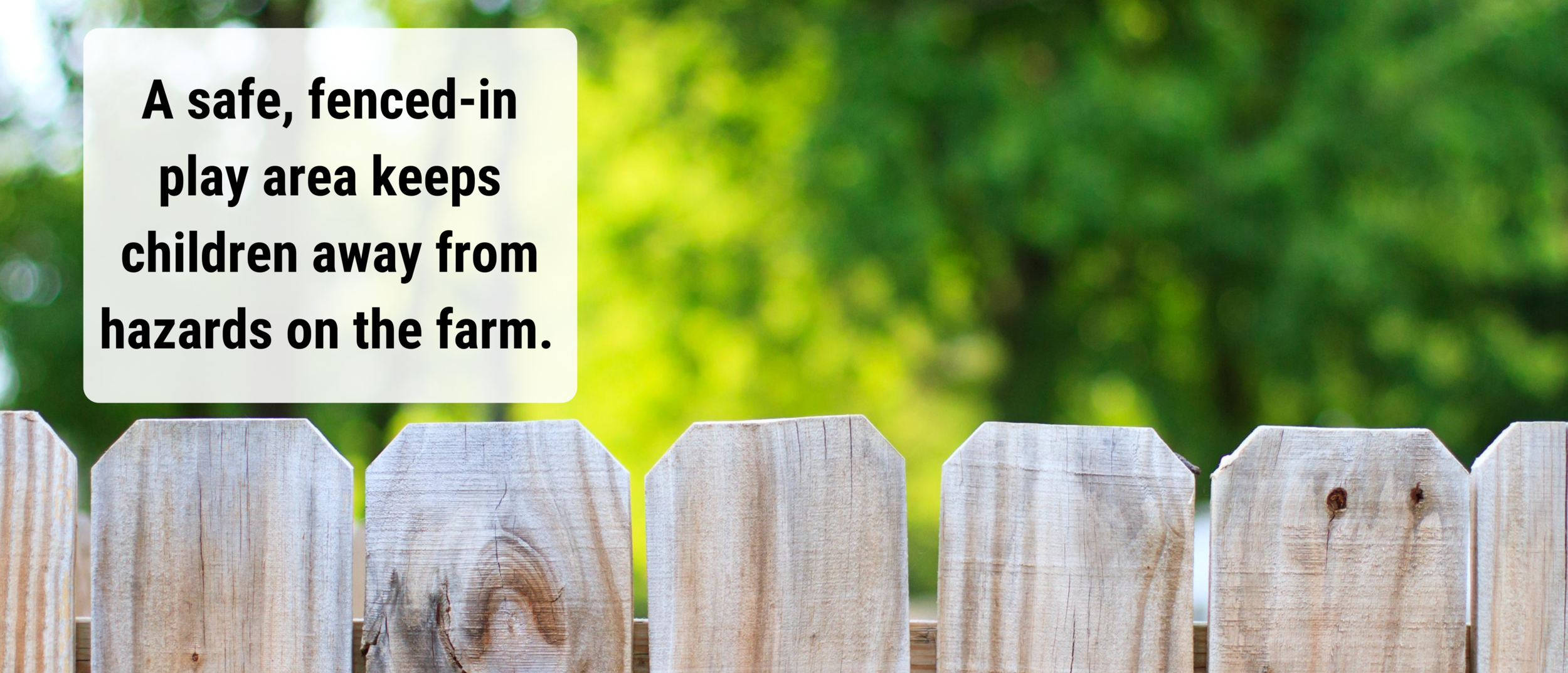
In recognition of National Farm Safety & Health Week, we are hosting an outreach week September 21–27 using our upcoming toolkit on fencing for farm safety. With a child dying from a farm-related injury every three days in the U.S., ag families are putting up fences to protect the next generation of farmers. Our toolkit materials will be available soon, so keep an eye on your inbox for our announcement.
Take Action
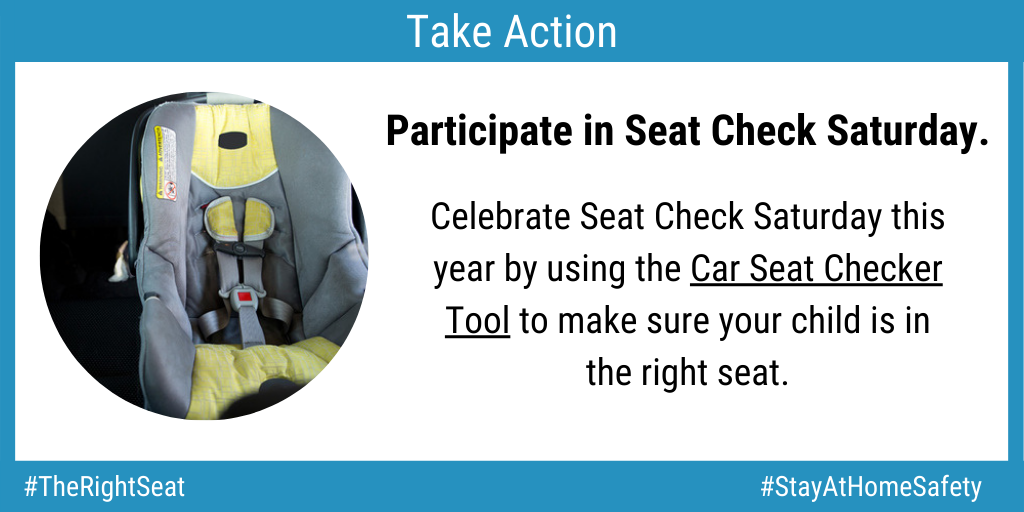
Every month, we are promoting a new action that each family can take to keep their children safer while social distancing. This month, we want every family to celebrate Seat Check Saturday by using the Car Seat Checker Tool from Nationwide Children’s Hospital. This tool will help you choose the correct seat for your infant or child based on their age, height, and weight.
Follow along every month for a new action, and share with us how you're preventing child injury in your home!
Coming Up
On Our Twitter Calendar
August 31 - Sept. 6: Baby Safety Month
Sept. 7 - 13: National Preparedness Month
Sept. 14 - 20: Concussion Awareness; National Concussion Awareness Day (Sept. 18)
Sept. 21 - 27: Child Passenger Safety Week; National Seat Check Saturday (Sept. 26); National Farm Safety & Health Week; Toolkit: Farm Safety
Sept. 28 - Oct. 4: Booster Seats
Events
Register for the 2020 Virtual Safe States Alliance Conference! Over the course of the 15 hour-long conference, attendees will have access to live video meetings, recorded sessions with real-time chat discussions, and opportunities to network directly with peers across the country. The conference will be held from September 9–11.
Join the National Peer Learning Team on Child Maltreatment, a collaborative initiative of the Colorado Department of Public Health and Environment and the Program for Injury Prevention, Education and Research (PIPER) at the Colorado School of Public Health, for a webinar on September 15th at 1PM EST. The webinar is titled, “Gun Violence as an Adverse Childhood Experience: Reflections from Research and Practice Perspectives,” and will be presented by Sonali Rajan, EdD, Danielle Kassow, PhD, and Ginny Rauh, ScD. Register here.
Join Kids In Danger (KID) for their third Best Friend Award Conversation on Thursday, September 17th from 6PM - 6:45PM CT. The conversation will feature journalists Rachel Rabkin Peachman from Consumer Reports and Stephanie Zimmermann of the Chicago Sun-Times and they will be covering children’s product safety. Register for free here.
Register for the free Annual FACTS Symposium 2020 on September 23rd from 11AM - 5PM EST. This year’s discussion, titled “The Science of Firearm Injury Prevention: Charting the Path Forward with Data and Innovation,” will feature research on racial disparities in police shootings, extreme risk protection orders (ERPOS), COVID-19 trends, and health provider counseling, among other essential topics.
Archived
August 2020: Back to School

School districts across the country are making difficult decisions about the upcoming school year, and parents are waiting hear about where their child will be spending their school day. Whether your child will be attending school in person, at home, or a combination of the two, staying injury-free and healthy is the goal. We have put together a few resources to keep your child safe while learning, whether they are at school or at home.
At School
Children get to school differently. Here are some resources if your kid is a walker, a biker, a bus rider, or rides in the car with you.
Safety tips for kids walking to school – Children’s Health
Teen Pedestrian Safety toolkit
Helping your child be a safe bicyclist – Walk & Bike to School
School Bus Safety – Safe Kids Worldwide
Distracted Driving toolkit
Make sure their backpack is the right size and weight to prevent back injuries, dress them for success on the playground, and remind them to play safely during recess.
Backpack Safety – HealthyChildren.org
Playground Safety: What Parents Need to Know – Children’s Wisconsin
In the Home
If your child will be staying at home during the week, it’s important to make sure that your home is a safe and healthy learning environment.
Home Safety Checklist – Safe Kids Worldwide
Home Safety for Teens – Safe Kids Worldwide
Make Safe Happen App – Nationwide Children’s Hospital
Lastly, we acknowledge that the stress of adapting to a new schedule, learning online, and following safety precautions against COVID-19 can take a toll on your child’s mental health. Here is a great resource that provides helpful tips on having difficult conversations with your child if they are struggling.
Quick Tip
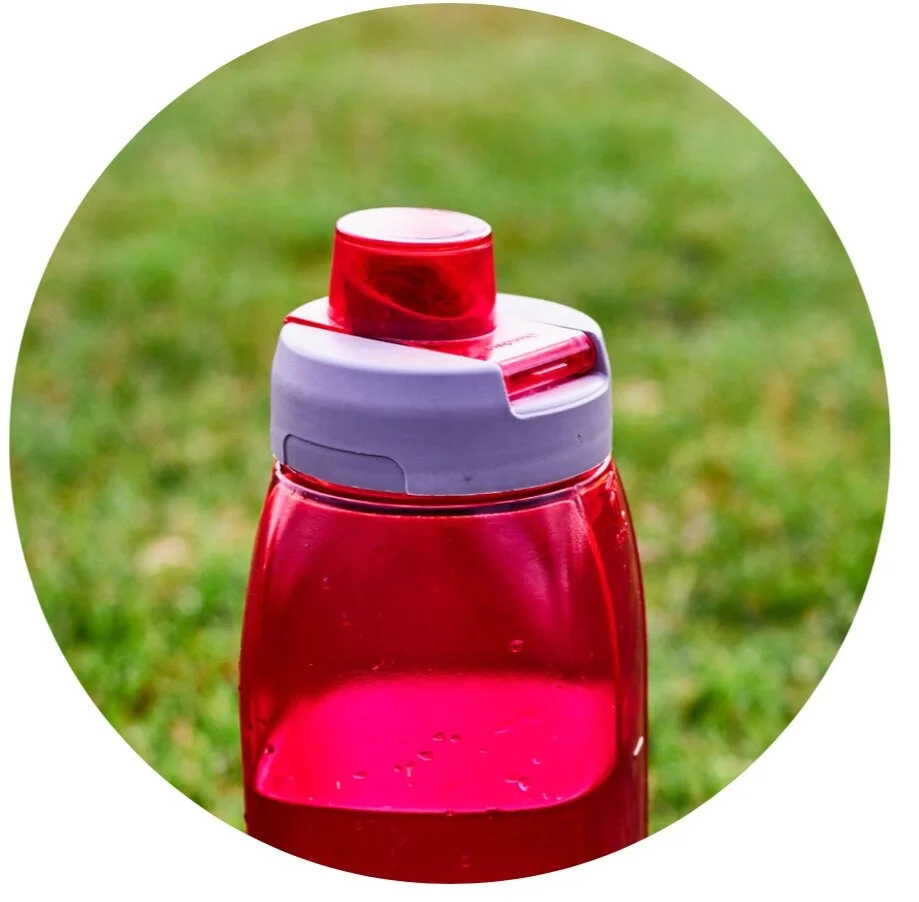
This year, some school sports teams and recreation leagues are requiring players to bring their own water bottles to prevent the spread of COVID-19. Make sure that your athlete has their own water bottle before sending them off to practice and games. Write your child’s name on the bottle and consider putting brightly colored tape, ribbons, or stickers on it so that it can be easily found on the sidelines.
Take Action
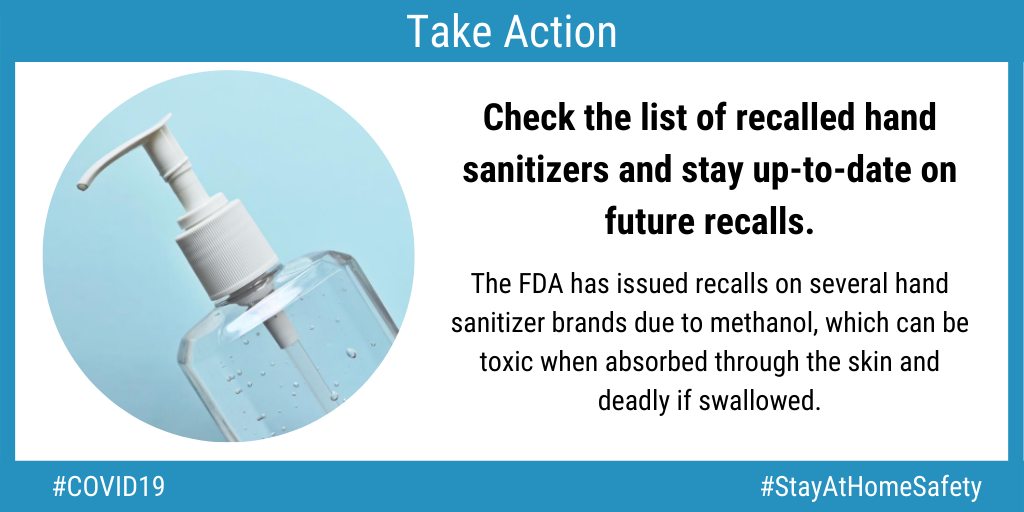
Every month, we are promoting a new action that each family can take to keep their children safer while social distancing. This month, we want every family to check the list of recalled hand sanitizers and stay up-to-date on future recalls for hand sanitizer products.
Recently, the FDA has been recalling and issuing warnings on several hand sanitizer brands due to them containing methanol. Methanol can be toxic when absorbed through the skin and deadly if swallowed. Click here to view the list of recalled products.
Follow along every month for a new action, and share with us how you're preventing child injury in your home!
Free Prevent Child Injury Pin
We are rewarding all of our members with a free Prevent Child Injury pin! If you’d like to receive a pin, please fill out this form and we will mail it to you. Your mailing address will be used for sending your pin only. If you have any questions or issues filling out the form, please email us at info@preventchildinjury.org.
Contest Winners
We have selected our contest winners! Congratulations to the following individuals:
Heather Hudson, for incorporating Prevent Child Injury into her curriculum
Lauren Willis, Rebecca Kinard, Christy Wald, and Sarah Hartwig, for their creative social media graphics
Mary Richardson, for filming a summer safety video for her students using tips from our toolkits
Thank you to all of you who entered, and congratulations to the winners!

Coming Up
On Our Twitter Calendar
August 3 - 9: Children’s Eye Health & Safety Month
August 10 - 16: Pedestrian Safety and Safe Routes to School
August 17 - 23: Back to School Safety; School Zone Safety
August 24 - 30: Safety Around Animals
Events
Join Kids in Danger for their second Best Friend Award Conversation with KID on Wednesday, August 5, 2020, from 6:00pm - 6:45pm Central. KID Executive Director Nancy Cowles will discuss children's product safety legislative achievements and the current regulatory environment with U.S. Rep. Jan Schakowsky (IL-9) and Remington Gregg, Counsel for Civil Justice and Consumer Rights of Public Citizen. Rep. Schakowsky and Remington Gregg are fierce advocates for children's product safety, and Rep. Schakowsky is a previous Best Friend Award honoree. Register for the event here.
Thank You Notes

Thank you to all who participated in our membership drive last month! We have so many new members of Prevent Child Injury, and we could not have achieved our goal without your help. Even though the drive is over, please continue referring others to become members of our coalition. We appreciate all of the hard work that you do to keep your communities safer.
Archived
July 2020: Fireworks

Fireworks and sparklers are common during summer holidays and celebrations. Unfortunately, nearly 10,000 firework-related injuries were treated in emergency departments in 2019. Public health and child injury professionals always recommend skipping the backyard displays and attending shows put on by professionals.
If your local public fireworks display has been cancelled this year due to COVID-19, there are plenty of safe alternatives to try! Glowsticks, party poppers, bubbles, and flags are all fun ways to celebrate the summer holidays.
There is no such thing as a “safe” firework. Sparklers, bottle rockets, and firecrackers are leading causes of firework-related injuries.
Approximately one-fourth of backyard fireworks injuries to children occur to those who are bystanders, so simply watching someone else use fireworks can put a child at risk. Families should carefully consider the risks of backyard fireworks, including sparklers, before using them.
Fireworks Safety Resources
Firework Safety – Nationwide Children’s Hospital
Fireworks Safety Tip Sheet – National Fire Protection Association
Stay Safe This 4th of July – HealthyChildren.org

COVID-19 Quick Tip
The 4th of July is the deadliest day of the year for children riding ATVs (all-terrain vehicles). Remember, ATV use is not recommended for children younger than 16 years. If you choose to allow your child to ride an ATV, follow these tips from our ATV Safety Toolkit to lower the chances of serious injury.
Start off right: Choose a youth model ATV designed for your child’s age (adult models are not safe for children younger than 16 years). Enroll your child in a hands-on training course.
Safety first: Only allow one person per ATV (no passengers). Wear recommended safety gear: a helmet certified by the Department of Transportation, ANSI, or the Snell Foundation, boots, gloves, goggles, and long pants and sleeves.
Off-road only: Use ATVs only on off-road terrain, never on paved surfaces or public roads of any type.
Take Action
Every month, we are promoting a new action that each family can take to keep their children safer while social distancing. This month, we want every family to put a life jacket on their children every time they are in and around water. Follow along every month for a new action, and share with us how you're preventing child injury in your home!

Membership Drive

Our first membership drive is taking place July 1st - July 31st. If you have benefitted from our program, spread the word with colleagues, peers, and friends! We want to reward those who refer others with a small bonus to show our appreciation. We have put together a page of social media posts, graphics, and a sample email to help you throughout the drive.
1 Referral: Prevent Child Injury Sticker
3 Referrals: Prevent Child Injury Spiral Notebook
10 Referrals: Entry to Win a Prevent Child Injury Swag Box
We will be tallying up referrals at the conclusion of the membership drive. Make sure to tell referrals to mention your name if you would like to receive the bonuses.
In addition, we are recognizing all existing and new members with a free Prevent Child Injury pin. We will be reaching out to all of you for mailing addresses if you are interested in receiving the pin. As always, please reach out to our team at info@preventchildinjury.org if you have any questions about our membership drive.
Coming Up
On Our Twitter Calendar
July 6 - 12: Hydration Safety
July 13 - 19: Open Water Safety
July 20 - 26: Fall Sports & Marching Band Readiness
July 27 - August 2: Heat Safety Awareness & Heatstroke Prevention Day (July 31)
Events
Join Memorial Hospital Miramar for the webinar “Infant Sleep Safety” on July 1st from 5:30 - 6:30PM EST. The webinar will cover the American Academy of Pediatrics’ recommendations for safe sleep, learning what a safe sleep environment looks like, and actions you can take to reduce the risk of infant sleep-related deaths. Register for the free webinar here.
The Region IV Public Health Training Center is hosting a live webinar titled “Health Equity in Young Children” on July 7th at 12PM EST. Ellyn Cochran (United Way of Greater Atlanta) and Kimberly Ross (Georgia Department of Health) will be discussing the preventable health disparities that occur in childhood and their effect on health outcomes later in life. Register for the free webinar here.
Archived
June 2020: National Safety Month
June is National Safety Month! This is a great time for everyone to come together to raise awareness about injuries that happen in our homes and communities. We can all help parents and caregivers to take steps to identify and address injury hazards. Celebrate National Safety Month by sharing the following resources with your family, friends, and peers.
Safety in the Home
AnchorIt! Secure Furniture and TVs – U.S. CPSC
Fall Safety for Kids: How to Prevent Falls – Mayo Clinic
Fire Safety – Safe Kids Worldwide
Poison Prevention & Treatment Tips – HealthyChildren.org
PoolSafely.gov – U.S. CPSC
You can find additional child injury prevention resources in our Why Injury Prevention Matters toolkit.
COVID-19 Quick Tip
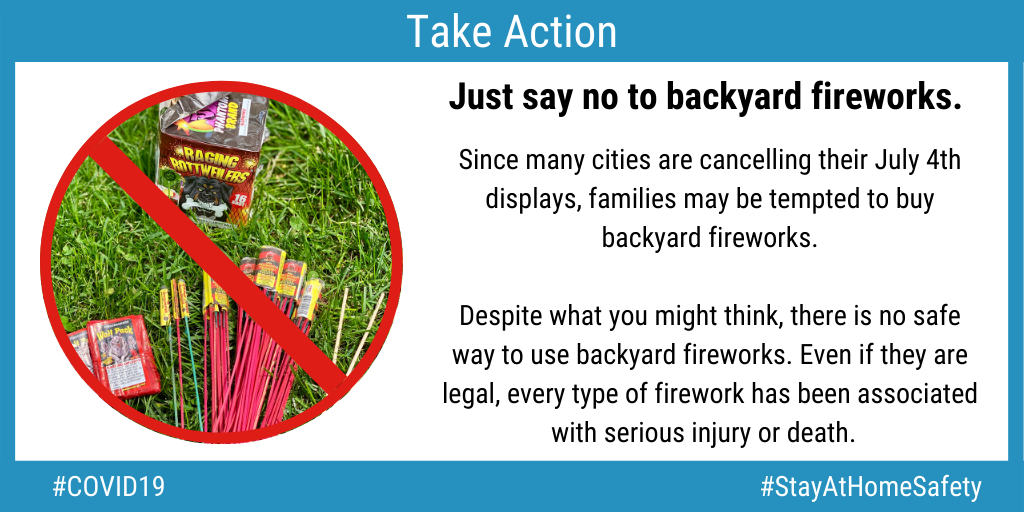
With public fireworks displays being cancelled across the country, families might be considering purchasing fireworks for a backyard show. Fireworks are more dangerous than many people think, and there is no safe way for you or your family to use fireworks. Approximately one-fourth of backyard fireworks injuries to children occur to those who are bystanders, so simply watching someone else use fireworks can put a child at risk. Families should carefully consider the risks of backyard fireworks, including sparklers, before using them.

Take Action
Every month, we are promoting a new action that each family can take to keep their children safer while social distancing. This month, we want every family to say no to backyard fireworks. Follow along every month for a new action, and share with us how you're preventing child injury in your home!
Contest
Only one month left to show us how you’ve been preventing child injury at home!
Document how you use our toolkits or participate in outreach weeks (our most recent outreach week was swimming pool safety!) with pictures, videos, or screenshots. Prizes will be awarded in the following categories:
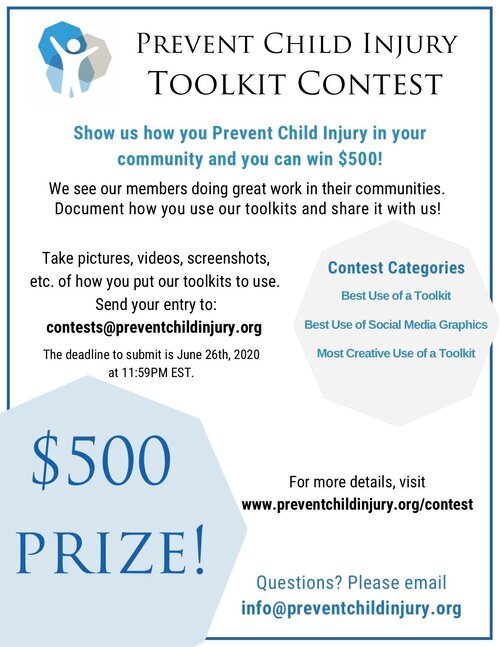
Best Use of a Prevent Child Injury Toolkit
Best Use of Prevent Child Injury Social Media Graphics
Most Creative Use of a Prevent Child Injury Toolkit
You don't have to submit to a specific category -- we will evaluate it to see which category it fits into best.
We will accept multiple submissions from the same individual/organization if it is not a copy of a previous submission. Share the contest guidelines with your friends, family, and colleagues!
Our contest is open until June 26th, 2020. Read more about the contest here. Please send submissions to contests@preventchildinjury.org.
Coming Up
On Our Calendar
June 1 - 7: National Safety Month
June 8 - 14: Safety In and Around Cars
June 15 - 21: Backyard Safety
June 22 - 28: ATV Safety
June 29 - July 5: Fireworks Safety Month
Events
Join Children’s Hospital of Philadelphia on June 2nd at 2PM EST for the webinar “Health & Safety Considerations for Reopening K-12 Schools.” Educators, administrators, and public health experts will share their perspectives on physical distancing, school health services, surveillance and testing, and more. To join via web browser for this event on June 2nd at 2PM EST, click here. If you are unable to join live, you can visit the PolicyLab website on June 3rd to access the archived video.
Lifesavers (The National Conference on Highway Safety Priorities) has chosen several select sessions that are available as free webinars. This is a great opportunity for child safety advocates, law enforcement, first responders, public health professionals, students, and researchers to learn from transportation and road safety experts. Review the list of available webinars and register for sessions here. The webinar will kick off June 3rd at 3PM EST.
The Society for Advancement of Violence and Injury Research (SAVIR) is hosting a webinar on June 9th from 12 - 1PM EST titled “Why should you tweet? Effective Twitter Usage for Injury & Violence Scholars.” Participants will learn how to grow their professional social media presence and hear from injury and violence professionals about how to use Twitter professionally. Register for the webinar here.
Archived
May 26th, 2020: Prevent Poisonings at Home
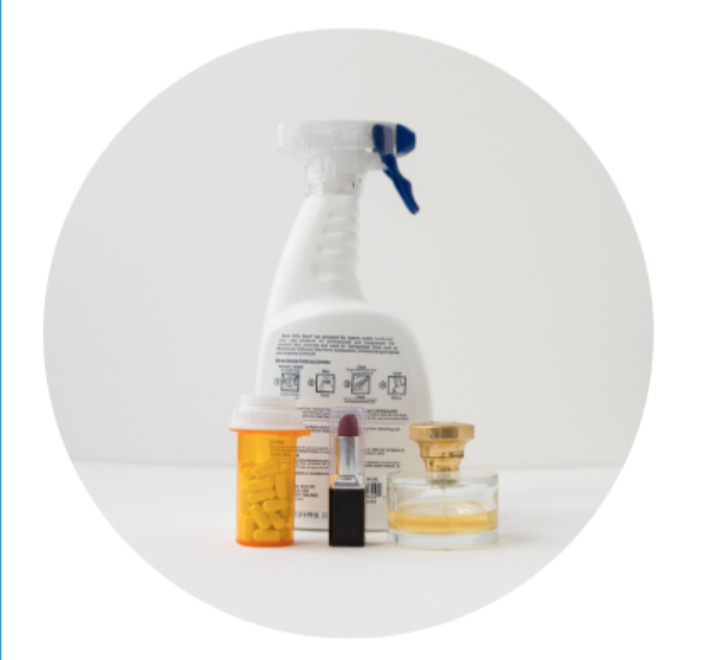
As families started staying at home to help fight COVID-19, they stocked up on cleaning products, hand sanitizer, and over-the-counter medicines. In addition, springtime gardening and yard work could mean that pesticides and fertilizers make their way into the home. Unfortunately, poison control centers have seen a spike in calls related to bleach, sanitizers, and disinfectants. Now more than ever, it is important to practice safe use and storage of poisonous products.
Hand Sanitizer: Small amounts of hand sanitizer can poison a child and can be fatal. Always supervise children when using hand sanitizer and keep it out of reach when not in use.
Disinfectants & Bleach: Use cleaning products as directed, and always keep them in their original containers. Do not combine or mix cleaners, as toxic fumes can be produced. Keep cleaning products out of reach and locked away.
Pest control & gardening products: Keep children inside while the lawn or garden is being sprayed for pests. Poison can be absorbed through the skin, through the mouth, or by breathing vapors. HealthyChildren.org recommends keeping kids “off the lawn after a chemical fertilizer has been applied until it's been exposed to at least a quarter inch of rain or a good watering. Then, wait at least 24 hours before you allow kids to play on the lawn.”
Medicines: If you have young children, store all medicine in a place that is too high to see or reach, preferably in a locked cabinet. If you have teens in the home, a locked cabinet is the best choice. Tightly close and safely store all medication bottles after each use. Safely dispose of unused medication.
Poison control centers are available 24 hours a day, every single day (including holidays!). Do not hesitate to call Poison Help Line (800-222-1222) or go to their website if you suspect a child or family member has come in contact with a poisonous product.
Action of the Week
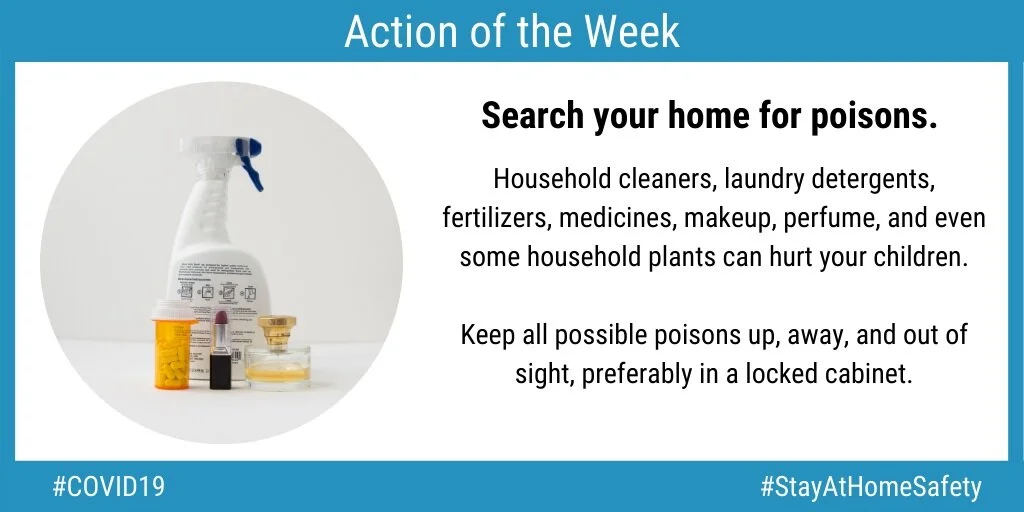
Every Monday, we are promoting a new, simple action that each family can take to keep their children safer while social distancing. This week, we want every family to search their home for poisons. Most families know to keep their children away from harsh cleaning products, but it’s important to remember that many substances can be harmful or deadly if used in the wrong way. Treat laundry detergents, fertilizers, medicines, makeup, perfume, and even some household plants like poison. Keep all possible poisons up, away, and out of sight, preferably in a locked cabinet. Check out these poison prevention tips by the National Poison Prevention Week Council.
Contest
Show us how you’ve been preventing child injury at home and you could win $500!
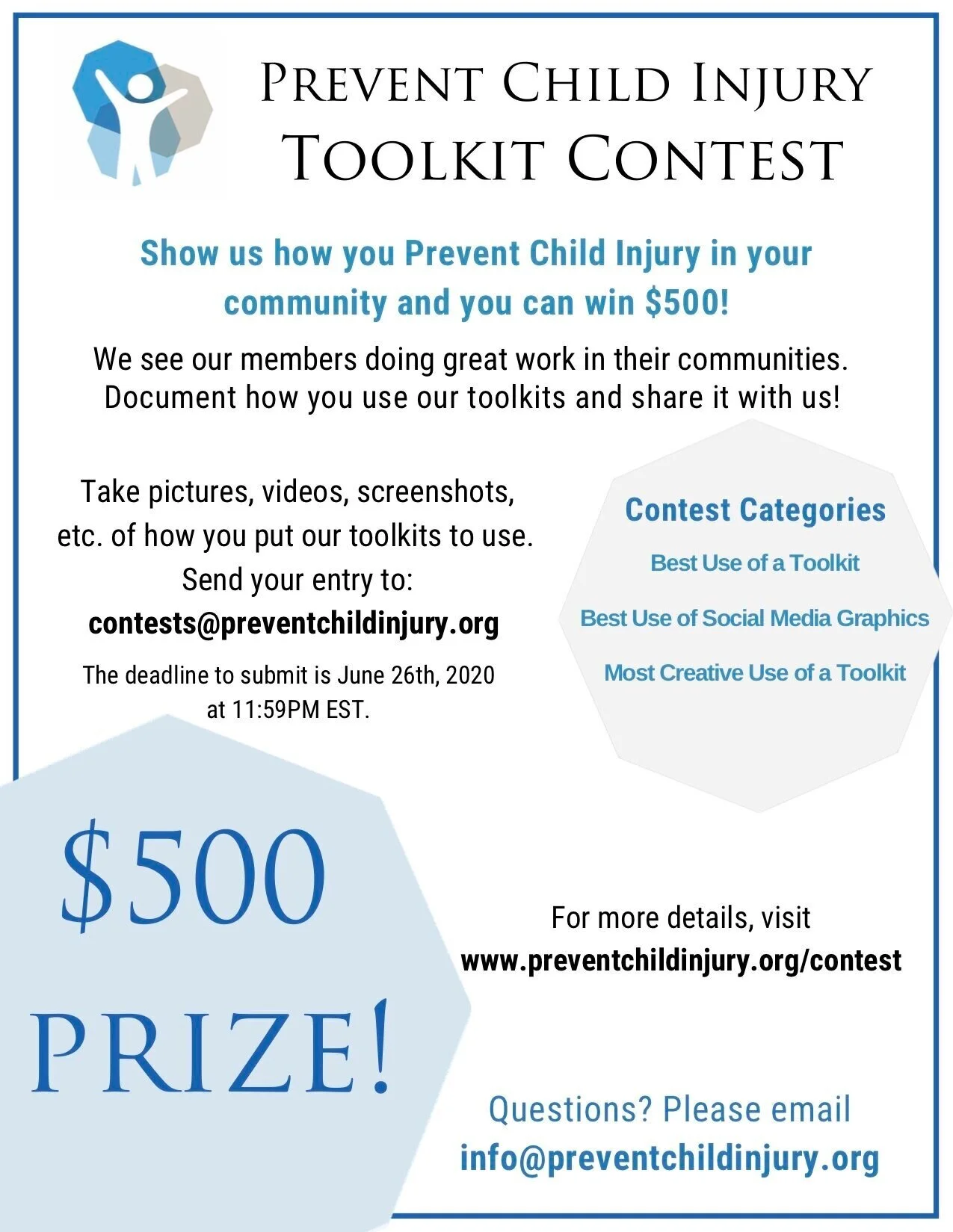
Document how you use our toolkits or participate in outreach weeks (our most recent outreach week was swimming pool safety!) with pictures, videos, or screenshots. Prizes will be awarded in the following categories:
Best Use of a Prevent Child Injury Toolkit
Best Use of Prevent Child Injury Social Media Graphics
Most Creative Use of a Prevent Child Injury Toolkit
You don't have to submit to a specific category -- we will evaluate it to see which category it fits into best.
We will accept multiple submissions from the same individual/organization if it is not a copy of a previous submission. Share the contest guidelines with your friends, family, and colleagues!
Our contest is open until June 26th, 2020. Read more about the contest here. Please send submissions to contests@preventchildinjury.org.
Coming Up
On Our Calendar
June: National Safety Month
Events
Attend the "Child Home Safety in the time of COVID: A Neglected Priority" Webinar, hosted by The George Washington University Injury Prevention Center and Safe Kids Worldwide, on May 27th at 11:30AM EST. Join the expert panelists for an engaging discussion on home safety. Register for the free webinar here.
Safe States is hosting a webinar on May 27th at 2:00PM EST titled “Drowning Prevention: Wading through the COVID-19 Impact.” Participate in the discussion on the impact of COVID-19 stay-at-home orders and parental distraction on drowning rates. Register for the free webinar here.
Announcement from the Safe Routes Partnership
The Safe Routes Partnership is putting together a Back to School 2020 Working Group to help develop strategies and resources for effectively implementing Safe Routes to School programs this fall. The group is looking for a broad range of Safe Routes to School practitioners, parents/caregivers, students, and advocates from across the country to join.
If you are interested in applying to participate in the Back to School 2020 Working Group, please complete this online application by Wednesday, May 27th. If you have questions, feel free to reach out to kori@saferoutespartnership.org or Becky Gilliam at becky@saferoutespartnership.org.
If you are not interested in participating in the working group but would like guidance on a particular topic, you can submit questions and comments via this online form. These questions will help inform the Back to School 2020 Working Group agenda and forthcoming materials.
Archived
May 18th, 2020: Skin Cancer Awareness Month & Don’t Fry Day (May 22nd)

While skin cancer is rare in children, 1 in 5 Americans will develop skin cancer in their lifetime. Experiencing just one bad sunburn as a child or teen, or five sunburns by any age, doubles your risk of getting melanoma, a type of skin cancer. Families may be feeling cooped up after a long winter and rainy spring, especially while social distancing and staying at home. However, it’s important to resist the urge to spend all day in the sun without protection. Follow these sun safety steps to enjoy the warmer weather safely:
Stay in the shade whenever possible and avoid midday sun. UV rays are especially strong between 10 AM and 4 PM.
Cover up with a wide-brimmed hat and a long-sleeved shirt and long pants.
Wear UV-blocking sunglasses. Look for a tag that says the lenses block 99% or more UV radiation.
Use sunscreen every day. Use a broad-spectrum (UVA/UVB) sunscreen with an SPF of 30 or higher. Be sure to reapply every 2 hours or after swimming or sweating.
For infants under the age of 6 months, the AAP states, “Use sunscreen on small areas of the body, such as the face, if protective clothing and shade are not available.”
The Fourth Annual National Sun Safety Day, Don’t Fry Day, promotes education and awareness about sun safety before many families spend time outdoors over Memorial Day weekend and begin the season of summer outdoor activities.
Dr. Sarah Denny Gives Parents the AAP’s Tips on Protecting Children from Sunburn (Video)
COVID-19 Quick Tip
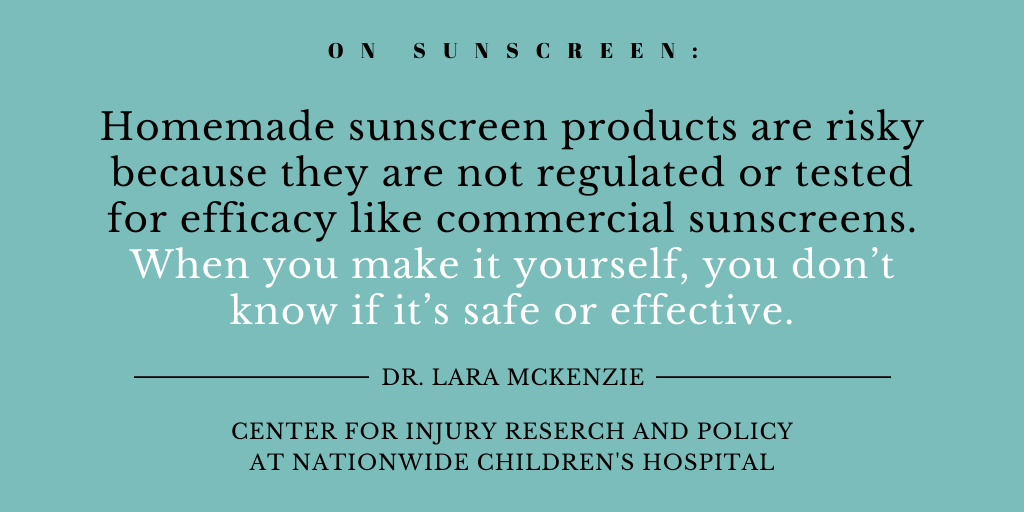
To avoid heading to the store, some parents may be tempted to make “homemade” sunscreen to protect their child’s skin from harmful rays. It’s important to resist the urge to get creative — with homemade sunscreen, you can’t be sure that it is safe or effective. Homemade products are not regulated or tested like the products you can buy at the store.
Homemade Sunscreen Recipes Promise Protection, But May Put Kids At Risk for Burns
Action of the Week
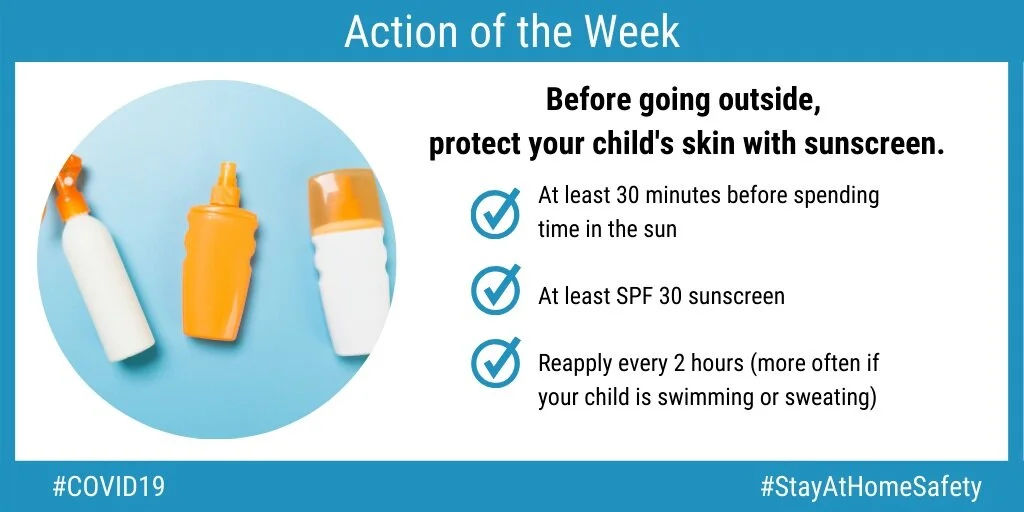
Every Monday, we are promoting a new action that each family can take to keep their children safer while social distancing. This week, we want every family to protect their children’s skin with sunscreen. When applying sunscreen, it’s important to put it on at least 30 minutes before spending time in the sun. Make sure it is at least SPF 30, and reapply every 2 hours (apply more often if your child is sweating or swimming). For more information about sun safety and sunscreen, check out this page from HealthyChildren.org.
Contest
Show us how you’ve been preventing child injury at home and you could win $500!
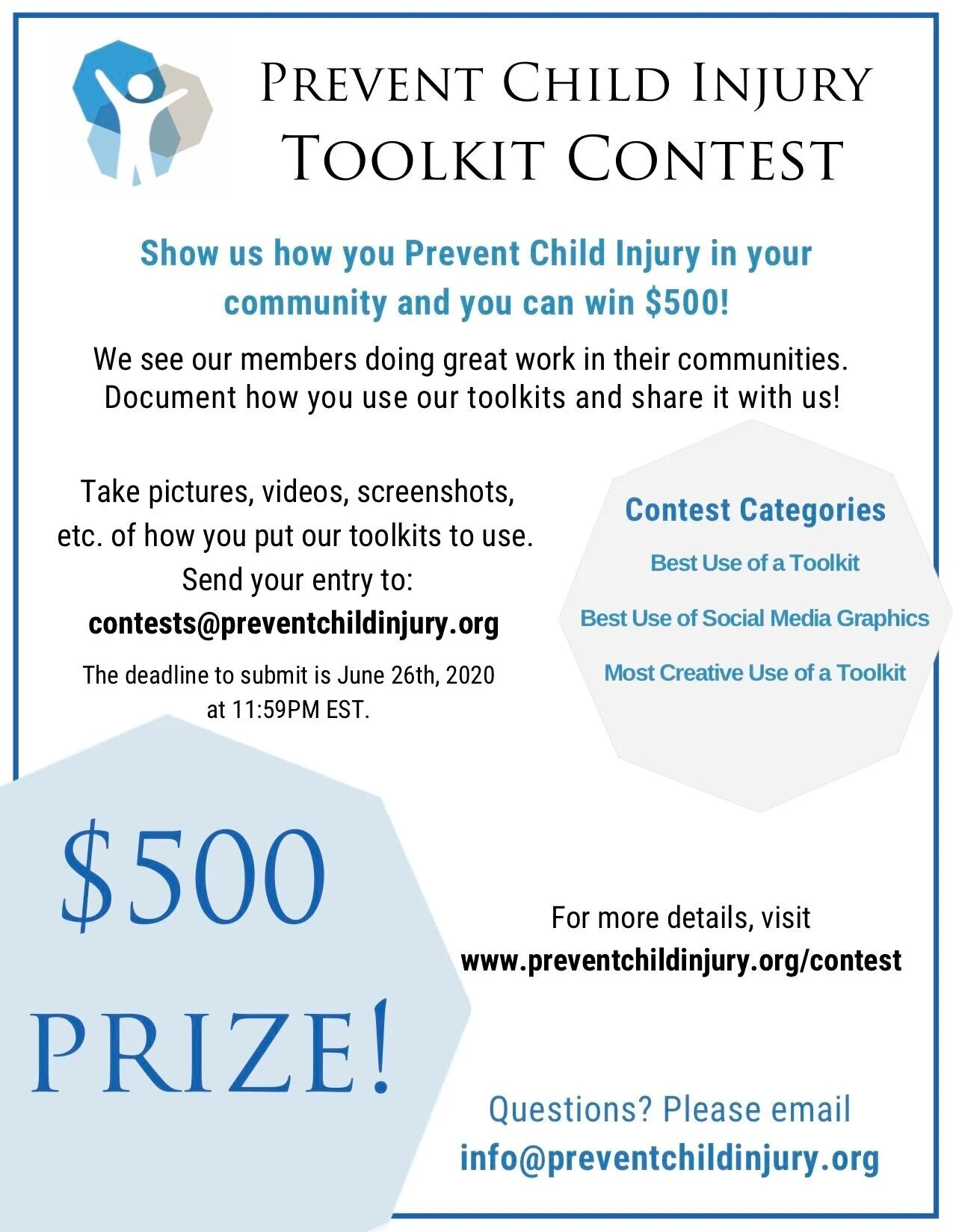
Document how you use our toolkits or participate in outreach weeks (our most recent outreach week was last week’s swimming pool safety!) with pictures, videos, or screenshots. Prizes will be awarded in the following categories:
Best Use of a Prevent Child Injury Toolkit
Best Use of Prevent Child Injury Social Media Graphics
Most Creative Use of a Prevent Child Injury Toolkit
You don't have to submit to a specific category -- we will evaluate it to see which category it fits into best.
We will accept multiple submissions from the same individual/organization if it is not a copy of a previous submission. Share the contest guidelines with your friends, family, and colleagues!
Our contest is open until June 29th, 2020. Read more about the contest here. Please send submissions to contests@preventchildinjury.org.
Coming Up
On Our Calendar
May 25 - 31: Poison Prevention at Home
June 1 - 7: National Safety Month
Events
Attend Columbia University’s ICRC Annual Injury and Violence Prevention Conference this Thursday, May 21st, from 10AM - 4PM EST. “The conference will provide the opportunity to converse with your injury prevention colleagues in academia, health departments, hospitals and other organizations to discuss cutting-edge research and best practices in injury and violence prevention.” Register (for free!) for the conference here.
The Children’s Safety Network (CSN) is hosting a webinar titled “Highlights from the Child Safety Learning Collaborative” on Thursday, May 21st from 3 - 4PM EST. The webinar “will highlight how states work together through the CSLC to achieve health results by building capacity to improve state injury and violence prevention systems.” Register for the webinar (for free!) here.
Thank You Notes

Thank you to all who reached out to us about registering for the 4th Annual National Summit for Health Communication! We were thrilled by how many of our members were interested in learning more about health communication. We hope to have more opportunities like this in the future, so stay tuned.
We also want to thank all of you for participating in our swimming pool safety outreach week! We appreciate all of the hard work that you do to keep your communities safer.
Archived

May 11th, 2020: Swimming Pool Safety & National Water Safety Month
May is National Water Safety Month! Drowning is the leading cause of death for children 1 - 4 years old, and the second leading cause of injury death for children 5 - 9 years old. While rates of drowning fatalities have been decreasing since 1985, drowning still claimed the lives of nearly 1,000 children in 2017.
It’s important to discuss water safety every year when the weather starts warming up and families begin going to beaches, lakes, and pools. Check out the American Academy of Pediatrics’ comprehensive Drowning Prevention Toolkit for infographics, videos, and social media posts on water safety for children of all ages.
Toolkit Outreach Week
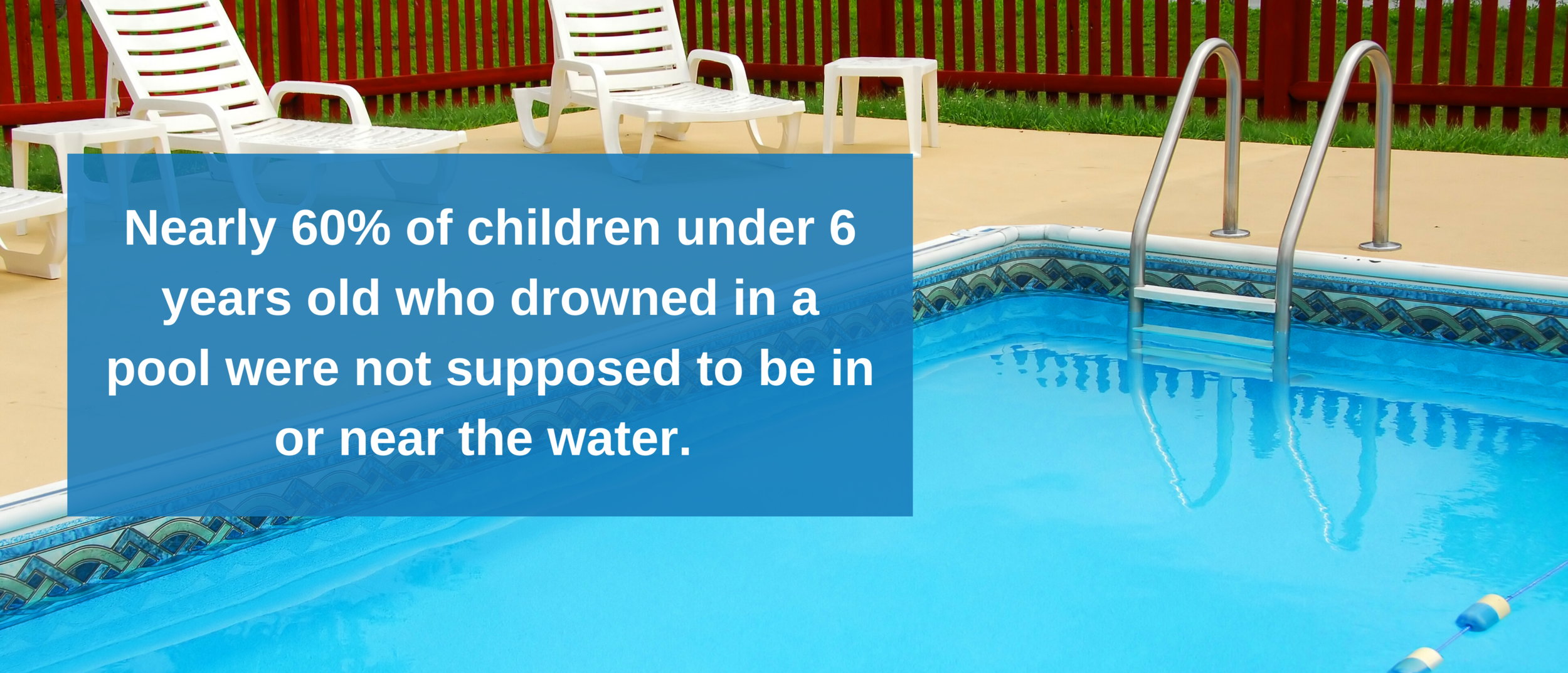
In recognition of National Water Safety Month, we are hosting an outreach week May 11th - 17th using our new toolkit on swimming pool safety. Nearly 60% of children under 6 years old that drown in swimming pools were not supposed to be in or near the pool when found. Because of this, we focused on a few of the “layers of protection” that are necessary in preventing children from accessing the swimming pool without an adult present. Our toolkit focuses on these key messages:
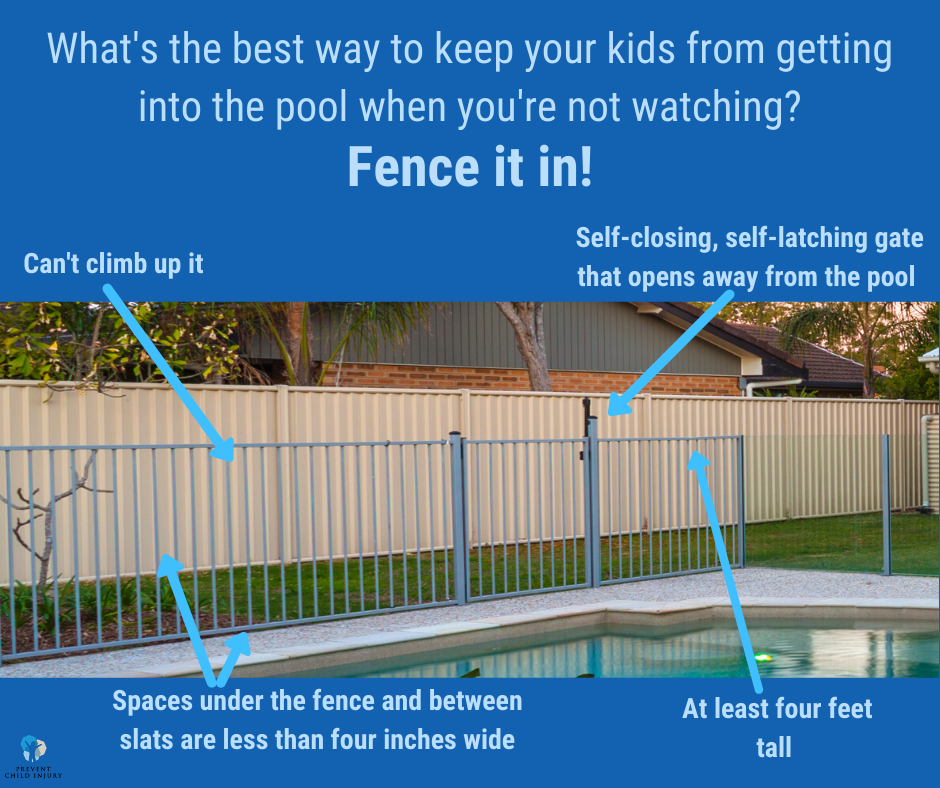
Use Physical Barriers: Make sure all swimming pools (including inflatable above-ground pools) are surrounded by a fence that is at least 4-feet high and has a self-closing, self-latching gate. The fence should not have openings (either underneath or between the slats) that are more than 4 inches. Empty smaller pools after every use.
Safety Barrier Guidelines for Residential Pools — Consumer Product Safety Commission
Install Alarms: Install alarms on all doors that lead outside. These alarms make a sound when the door is opened to warn adults that a child might have gone outside. Put pool alarms in the water itself. These alarms sound an alert when there are waves in the water, which could mean that someone has fallen into the pool.
Pool Safely Step 4: Alarms (Video) — Pool Safely
Why You Need to Invest in a Pool Alarm This Summer — Good Housekeeping
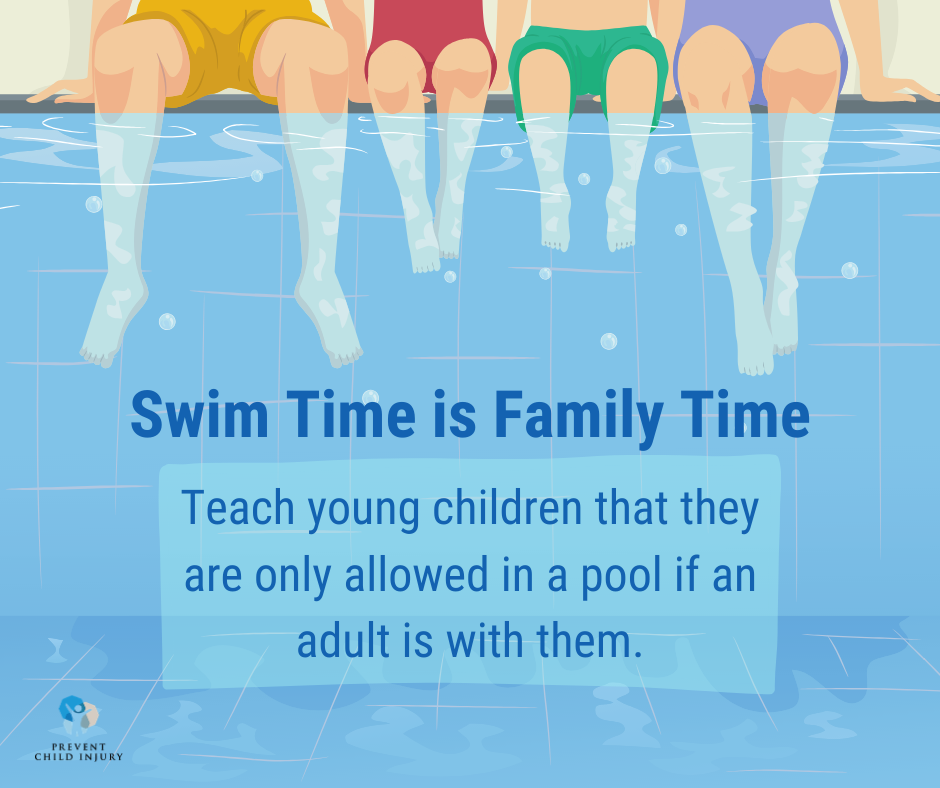
Swim Time is Family Time: Teach young children that being in or around the pool is only done with adults around – never by themselves. Put away all pool toys when swim time is over so that children are not tempted to go near the pool unsupervised.
Swimming Safety Tips — Safe Kids Worldwide
Please add swimming pool safety to your outreach plans for this week, and use our materials — including graphics, social media posts, newsletter, and press release — to raise awareness about swimming pool safety and drowning prevention.

COVID-19 Quick Tip
With some public pools delaying opening or closing for the summer, we have heard reports of families buying portable and above-ground pools for their backyards. These can be just as dangerous as permanent pools, so it’s important to keep these safety tips in mind when purchasing a portable pool:
Action of the Week
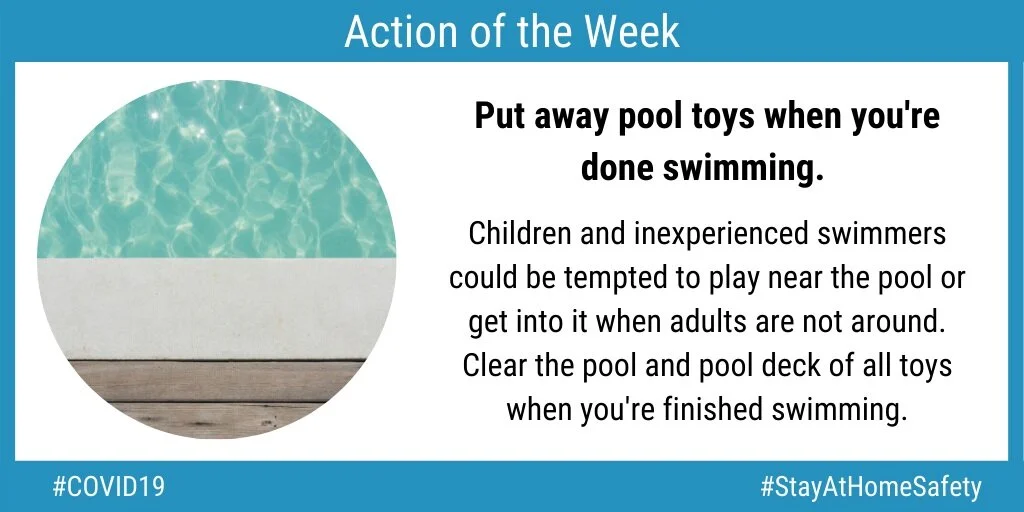
Every Monday, we are promoting a new action that each family can take to keep their children safer while social distancing. This week, we want every family to clean up and put away pool toys when everyone is finished swimming. Children could be tempted to play near the pool without an adult present if toys are left out. Children could also try to reach in to grab toys that are floating in the pool, risking falling into the water.
Coming Up
On Our Calendar May 18-24: UV Awareness Month, Don’t Fry Day (May 22nd) May 25-31: Home Poisons
Events
Attend Columbia University’s ICRC Annual Injury and Violence Prevention Conference next Thursday, May 21st, from 10AM - 4PM EST. “The conference will provide the opportunity to converse with your injury prevention colleagues in academia, health departments, hospitals and other organizations to discuss cutting-edge research and best practices in injury and violence prevention.” Register (for free!) for the conference here.
The Children’s Safety Network (CSN) is hosting a webinar titled “Highlights from the Child Safety Learning Collaborative” on Thursday, May 21st from 3 - 4PM EST. The webinar “will highlight how states work together through the CSLC to achieve health results by building capacity to improve state injury and violence prevention systems.” Register for the webinar (for free!) here.
Archived
May 4th, 2020: National Bike Safety Month & Bike to School Day
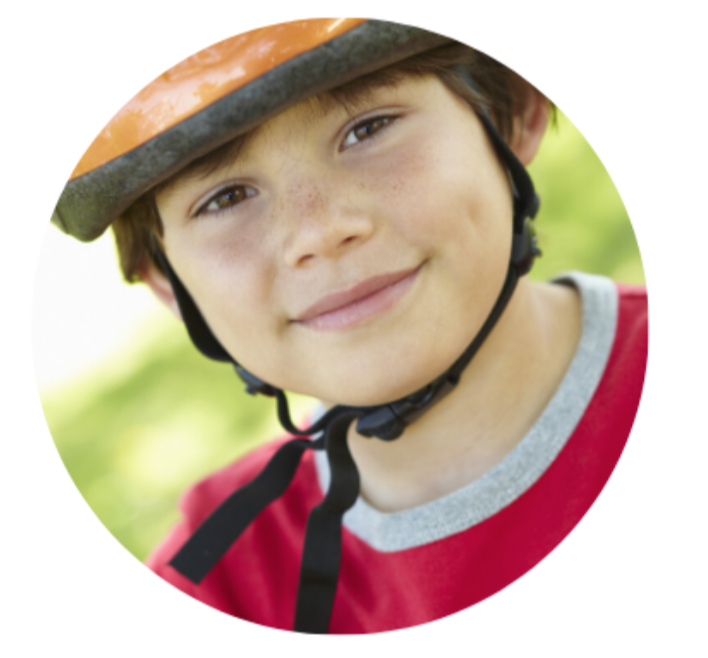
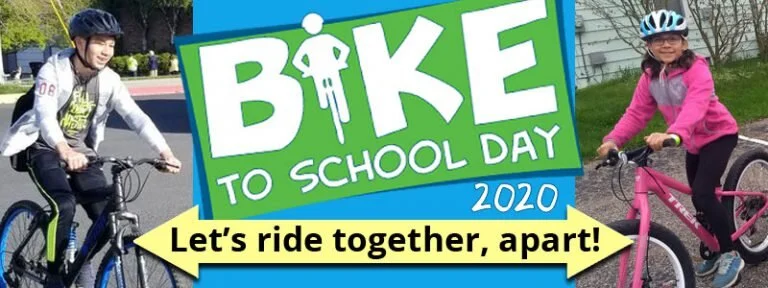
May is National Bike Safety Month, and this Wednesday, May 6th, is National Bike to School Day! Social distancing doesn’t mean you can’t spend time outside, and many healthcare professionals are recommending spending time in nature and getting active to improve mental health. Celebrate National Bike Safety Month by putting on your helmets, following all road safety laws, and taking the family for a ride in your favorite park or around the neighborhood.
Every year since 2012, Walk & Bike to School hosts Bike to School Day (May 6th), which encourages healthy habits, a cleaner environment, a close-knit community, and an opportunity to promote safety while bike riding. Because schools are closed due to COVID-19, Walk & Bike to School has planned an entire week devoted to focusing on safety, community, and fun. Participate in their events and connect on social media to share how your family is recognizing Bike to School Day from a distance. Learn more about what they have planned here: http://www.walkbiketoschool.org

Bike Safety Resources
Bicycle Safety - National Highway Traffic Safety Administration
Rules of the Road for Riding Safely - National Highway Traffic Safety Administration
Safety in Seconds: Bike Helmets (Video) - Safe Kids Worldwide
On Bike or Foot, Help Kids Prevent Injuries With These 3 Safety Tips - Safe Kids Worldwide
Bicycle Helmets - Nationwide Children’s Hospital
Action of the Week
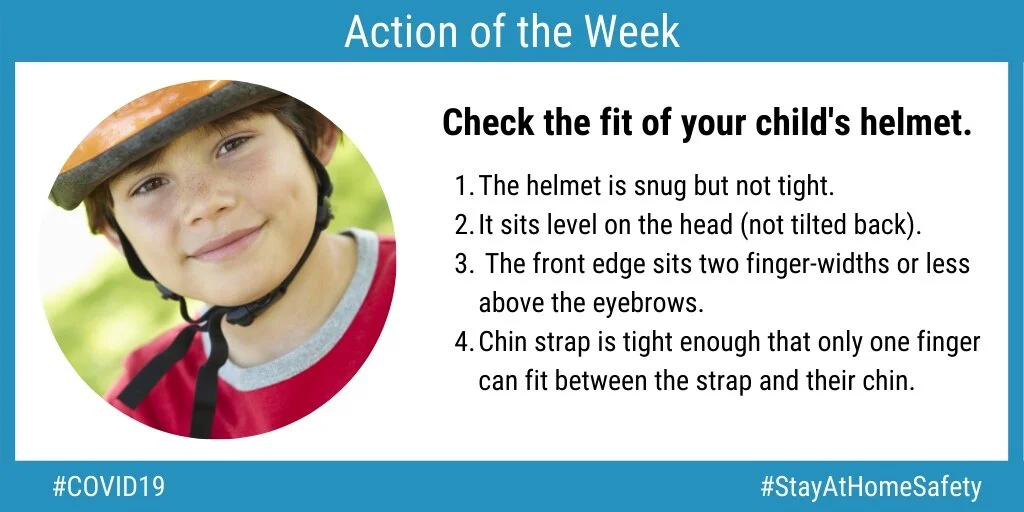
Every Monday, we are promoting a new, simple action that each family can take to keep their children safer while social distancing. This week, we want every family to check the fit of their child’s helmet. It’s important that your child’s helmet fits correctly in order to prevent dangerous head injuries. When fitting a child for a helmet, make sure to check the following steps:
The helmet is snug but not tight
It sits level on the head (not tilted back)
It sits low on the forehead (one or two fingers width from the eyebrows to the helmet)
The chin strap is snug, with no more than one finger able to fit between the chin and the strap
For more information on fitting a helmet, check out this resource from NHTSA, the National Highway Traffic Safety Association: https://www.nhtsa.gov/sites/nhtsa.dot.gov/files/8019_fitting-a-helmet.pdf
Coming Up
On Our Calendar May 11-17: Toolkit Outreach Week: Swimming Pool Safety May 18-24: UV Awareness Month, Don’t Fry Day (May 22nd)
Events
Kids In Danger is hosting a “Safe From the Start” webinar on May 7, 2020 (1 - 2 PM CT). Nancy Cowles, KID Executive Director, will be discussing children's product safety, including recalled products, furniture tip-overs, and choking and ingestion hazards. She will also be talking about creating a safe sleep environment for infants. A Q&A session will follow. RSVP for this event here. (Sign up early—seats are limited, and this event was created to accommodate overflow from the April 29 webinar).

Just in time for National Water Safety Month, our swimming pool safety toolkit promotes the "layers of protection" necessary to prevent children from accessing the pool without an adult present. The toolkit contains a customizable press release, newsletter/blog article, photo guidelines, social media posts, a Pinterest board, graphics, and links to additional resources which provide supplementary information. Our campaign is May 11th - 17th, 2020, so if you haven't done so already, please take some time to add swimming pool safety to your social media and outreach plans for that week. You can view the toolkit here: https://www.preventchildinjury.org/toolkits/swimmingpoolsafety
Archived
April 27th, 2020: Home Playground Safety
This week is National Playground Safety Week! Although many states have closed public playgrounds to stop the spread of COVID-19, some families have playground equipment in their own backyards. Unlike public playgrounds, though, these backyard fun zones aren’t inspected and maintained by professionals, so parents and caregivers should carefully check their equipment for safety before the kids start to play.
Resources on Playground Safety
Home Playground Safety Checklist – U.S. Consumer Product Safety Commission
Outdoor Home Playground Safety Handbook – U.S. Consumer Product Safety Commission
Playground Safety (English) – healthychildren.org
Playground Safety (Español) – healthychildren.org
Playground Safety – Injury-Free Coalition for Kids
Safety Tips for Home Playground Equipment (English) – healthychildren.org
Safety Tips for Home Playground Equipment (Español) – healthychildren.org

Playground Safety: Safe Surfaces toolkit – Prevent Child Injury
Action of the Week
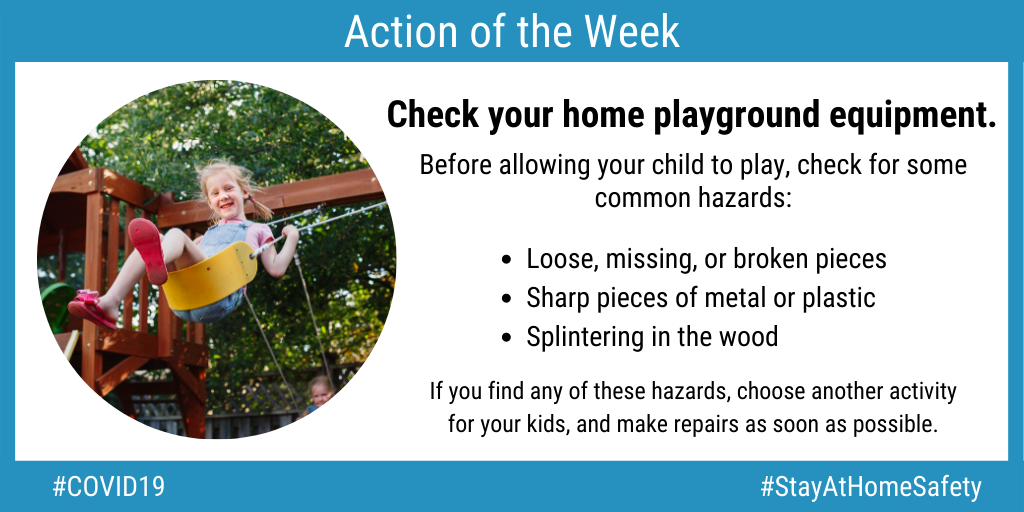
Every Monday, we are promoting a new action that families can take to keep their children safer while social distancing. Because it’s National Playground Safety Week, we’re encouraging families to check their backyard playground equipment. Before your kids run out to play, look over your equipment for some common hazards: loose, missing, or broken pieces; sharp pieces of metal or wood; and splintered wood.
COVID Quick Tip
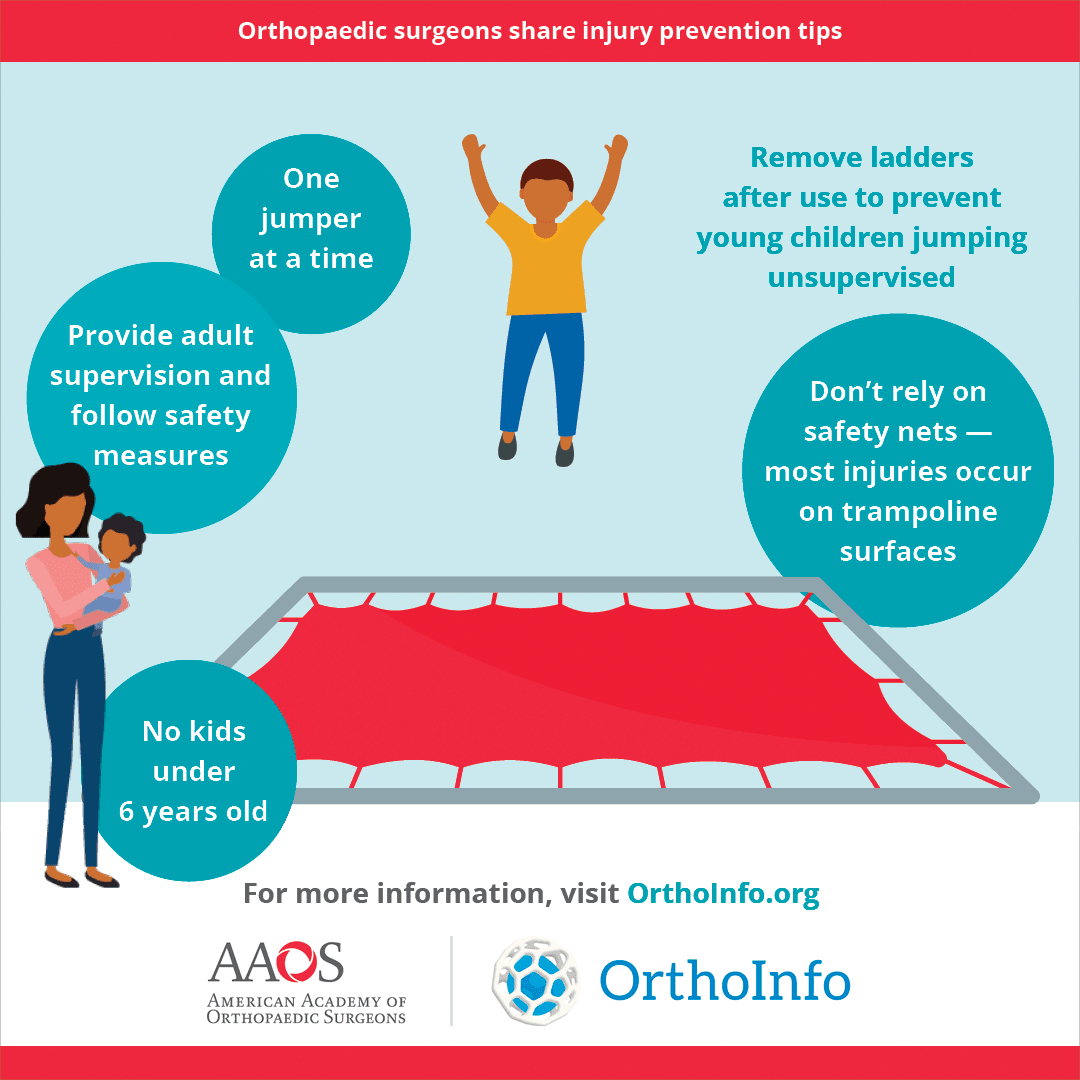
There have been reports of families buying more trampolines during stay-at-home orders, so emergency departments are expecting to see a rise in injuries relating to trampolines. Although the American Academy of Pediatrics recommends not buying trampolines, if you already have one, strongly enforce safety rules.
Trampolines: What You Need to Know (English) – healthychildren.org
Trampolines: What You Need to Know (Español) – healthychildren.org
“My daughter is begging for a backyard trampoline, but I’m concerned…” – Mayo Clinic
Coming Up
On Our Calendar
May 4-10: National Bike Safety Month
May 11-17: Toolkit outreach week: swimming pool safety
Events
Kids In Danger is hosting a “Safe From the Start” webinar on May 7, 2020. Nancy Cowles, KID Executive Director, will be discussing children's product safety, including recalled products, furniture tip-overs, and choking and ingestion hazards. She will also be talking about creating a safe sleep environment for infants. A Q&A session will follow. RSVP for this event here. (Sign up early—seats are limited, and this event was created to accommodate overflow from the April 29 webinar).

ArchiveD

April 20th, 2020: Youth Sports During COVID-19
This week, we will be talking about youth sports during COVID-19. School is out and sports seasons have been postponed — what does this mean for young athletes? Some will continue to train at home without the supervision of their coach. Injuries might occur from improper technique and overuse. Others have difficulty staying motivated and might be disappointed or angry that their sports seasons have been cut short. On the other hand, social distancing could provide a much-needed rest period for athletes that train all year long. We have compiled resources that address all of these topics to better support young athletes during this time.
Staying Injury-Free While Training at Home
inCourage: How to Keep Your Kids Safely Active…and Out of the Emergency Room
Safe Kids: Sports Safety Checklist for Parents, Sports Overuse Injury Tip Sheet, Dehydration Safety Tip Sheet
Health.com: We're All Doing At-Home Workouts Now—Here's How Not to Get Injured
Not specific to children and teens, but can be applied to any age
Encouraging Movement (Or Rest)
Addressing Disappointment
Lastly, the Aspen Institute’s Project Play initiative is hosting an interactive discussion titled “Coronavirus & Youth Sports: What Kids Need from Coaches Now” on Wednesday, April 22nd from 2 - 3PM EST. The webinar will feature young people and their coaches as well as resources from trusted professionals about physical health and social emotional well-being. Register for free here.
COVID-19 Quick Tip
Over the last few weeks, some emergency departments have been seeing an increase in ATV injuries. Please share these resources with your peers and your community to encourage safety on ATVs.

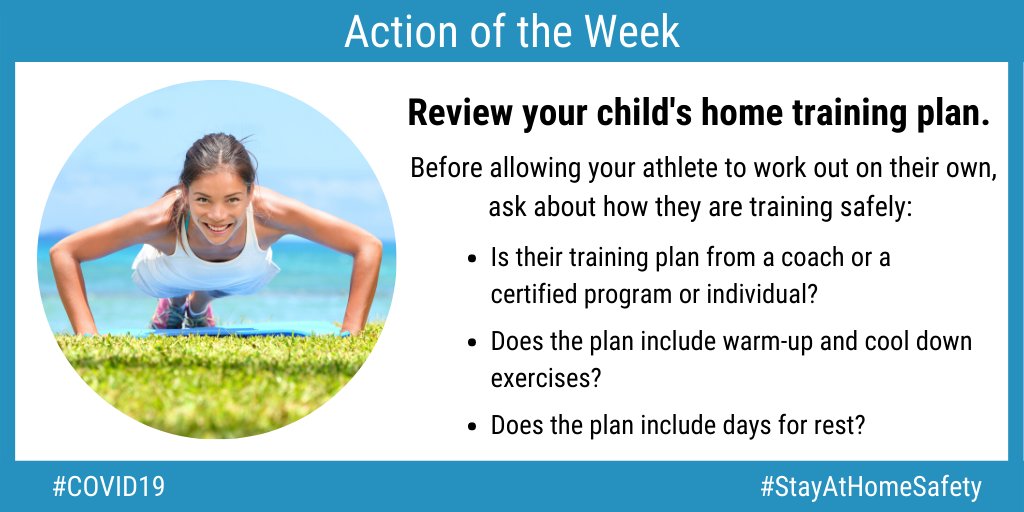
Action of the Week
Every Monday, we are promoting a new, simple action that each family can take to keep their children safer while social distancing. This week, we want every family to review their child’s home training plan. If you have a young athlete in your home, it’s important to make sure that they are training safely. Ask your child a few questions to be sure that their plan was given to them by their coach or a certified program or individual, that it includes warm-up and cool down exercises, and that it includes days for rest.
Coming Up
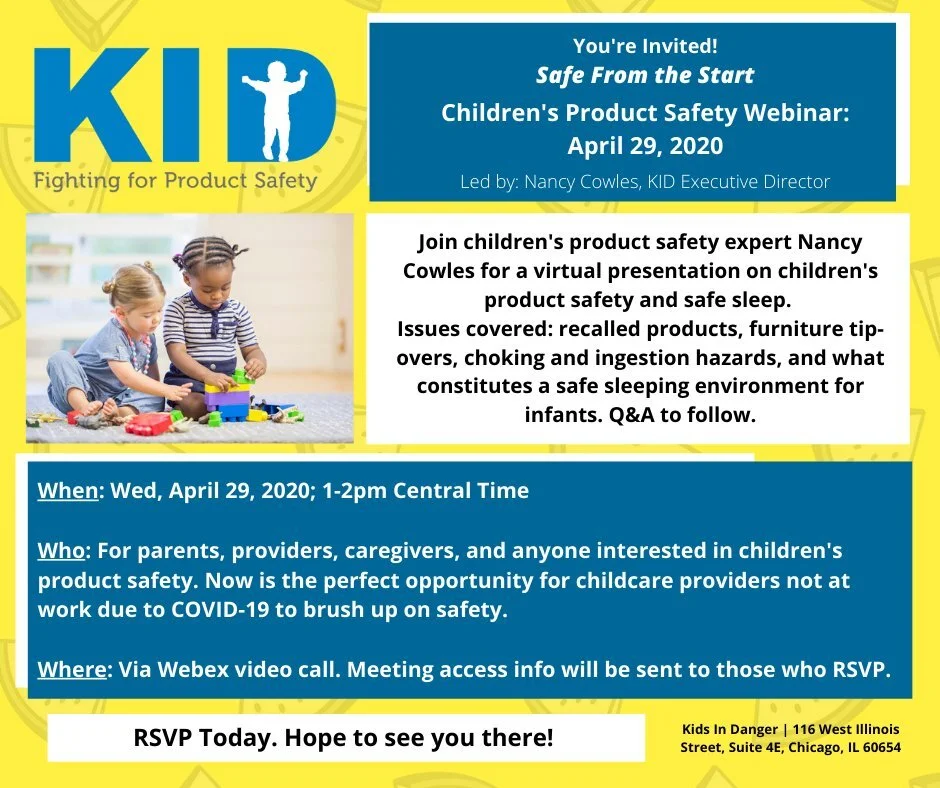
Kids In Danger is hosting a webinar next Wednesday, April 29th at 1PM Central Time. Nancy Cowles, KID Executive Director, will be discussing children's product safety, including recalled products, furniture tip-overs, and choking and ingestion hazards. She will also be talking about creating a safe sleep environment for infants. A Q&A session will follow. RSVP for this event here.
Next week’s newsletter will focus on National Playground Safety Week (April 27 - May 3), with a focus on backyard playgrounds, and the week after that we’ll be talking about National Bike Safety Month (May 4 - 10). If you or your organization has any materials or events about these topics that you would like us to promote to our members, please email info@preventchildinjury.org.
ARCHIVED
April 13th, 2020: Falls in the Home
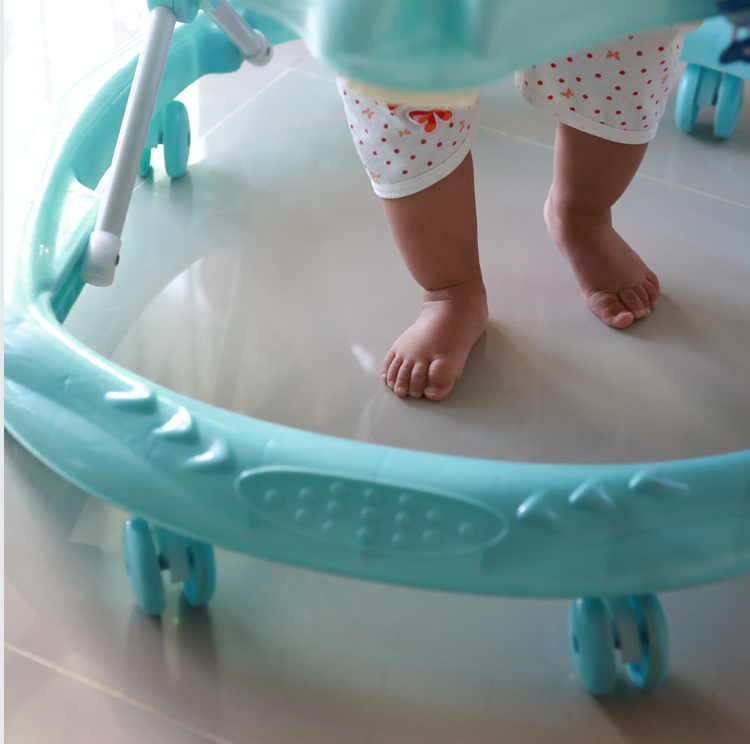
This week, we will be talking about falls that occur in the home. Falls are the leading cause of non-fatal injury for kids in the United States—nearly 8,000 kids are treated for a fall-related injury in the emergency room every day. Right now, while families are in their homes more than ever due to COVID-19, it’s important to address a few of the most common ways that children can fall so that parents can make their homes safer. Here are some links to resources to help get you started.



Furniture & TV Tip-overs
COVID-19 Quick Tip
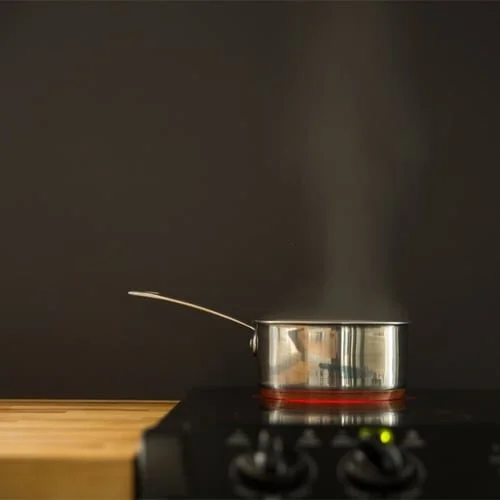
Over the last few weeks, some emergency departments have been seeing an increase in burn injuries primarily occurring in the kitchen. Please share these resources with your peers and your community to raise awareness on this emerging issue.
Action of the Week
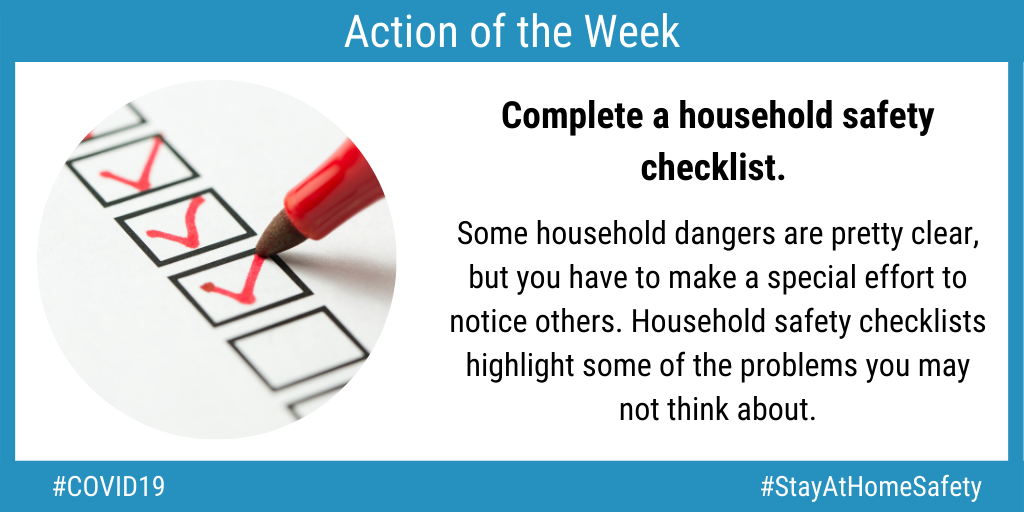
Every Monday, we are promoting a new action that families can take to keep their children safer while social distancing. This week, we are asking families to complete a household safety checklist. These checklists are helpful in identifying hazards in your home that you might not notice. KidsHealth has a checklist for nearly every room in the house and even has one for hazards outside of your home: https://kidshealth.org/en/parents/household-checklist.html
Coming Up
Next week’s newsletter will focus on National Youth Sports Safety Month (April 20 - 26), with an emphasis on backyard sports and training at home, and the week after that we’ll be talking about National Playground Safety Week (April 27 - May 1). If you or your organization has any materials or events about these topics that you would like us to promote to our members, please email info@preventchildinjury.org.
In Case You Missed It…
Last week was National Public Health Week, and there were several events that encouraged discussion from individuals and organizations across disciplines. On Monday, April 6th, the NPHW Forum: "NPHW @ 25: The Future of Public Health is Now" discussed public health’s strides in the last 25 years, the challenges of eliminating health disparities, and the imperative to create a more just world. A recording will be posted soon here: http://nphw.org/events/nphw-forum
Prevent Child Injury participated in a Twitter chat to “discuss all things public health, celebrate everything public health has accomplished and talk about where the movement is going” on Wednesday, April 8th. To see the conversation, find @NPHW on Twitter.
ARCHIVED
April 6th, 2020: Window Safety, National Public Health Week, and World Health Day (April 7th)
This week, we'll be talking about window safety, which includes window falls and injuries from window blind cords. Check out our toolkit and these resources from the National Safety Council to spread the word and share important safety tips about this hidden hazard.
Child injury is often overlooked during National Public Health Week and World Health Day, especially during a pandemic. With more children spending time in their homes due to school and daycare closures the risk of avoidable injury is high. So, this is an important topic to talk about, potentially now more than ever.
Prevent Child Injury and many other organizations have recognized this, and have created a collection of resources to share with your community.
Bookmark our page on COVID-19 that has links to great resources on this issue from many of our members with new information being added as it comes in.
Continue to use #StayAtHomeSafety when posting on social media.
Action of the Week
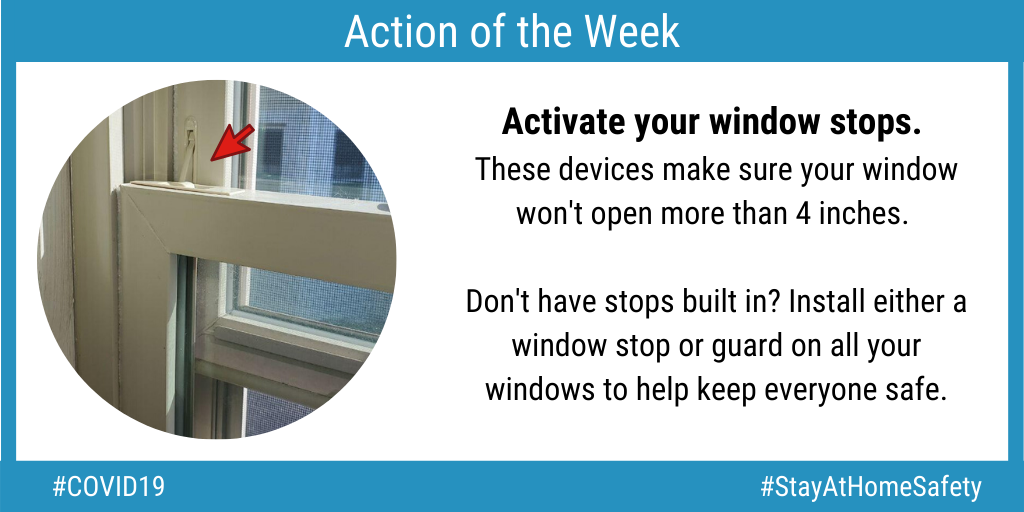
Every Monday, we are promoting a new, simple action that each family can take to keep their children safer while social distancing. This week, we want every family to think about how to keep the children in their home safer when they start opening the windows to let some fresh air in. Remember that window screens are meant to keep bugs out, not kids in. Activate your window stops or guards to make sure windows can’t open more than 4 inches. If you don't have stops built in and can’t get window stops or guards delivered this week, start by moving furniture away from windows to make it harder for kids to get to the window.
Coming Up
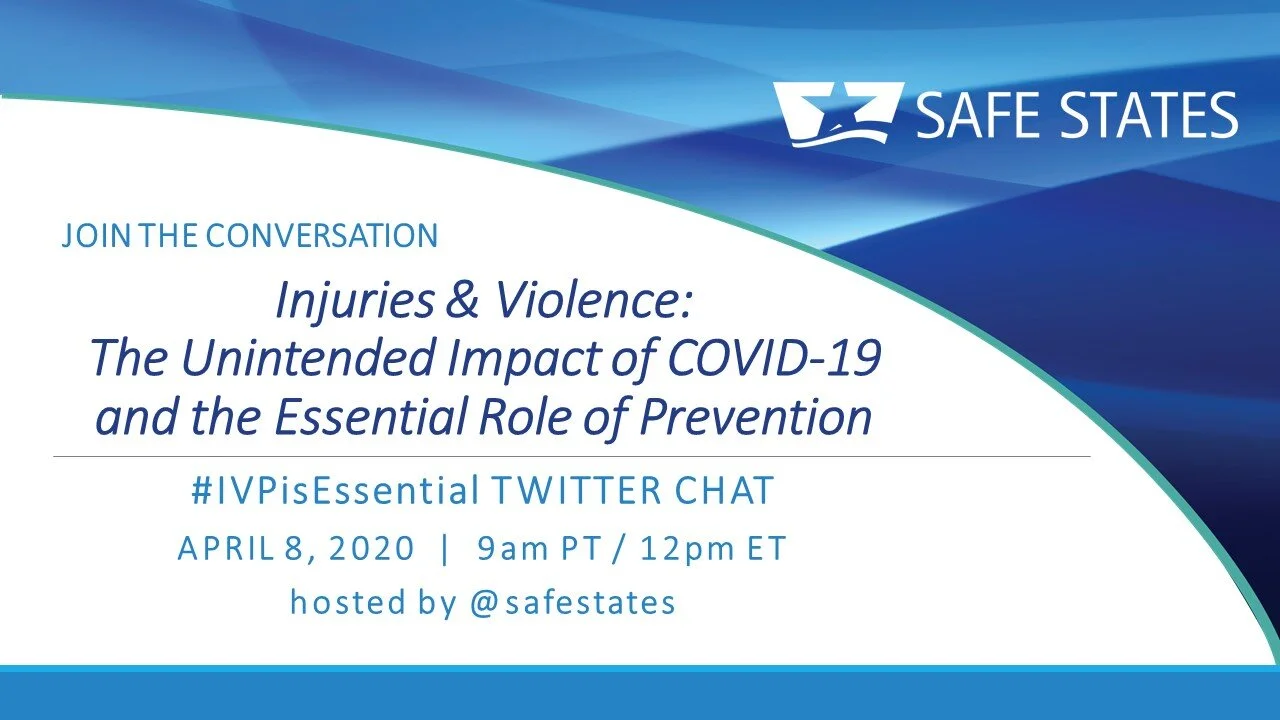
Safe States Alliance is hosting a Twitter chat titled “Injuries & Violence: The Unintended Impact of COVID-19 and the Essential Role of Prevention” on Wednesday, April 8th, at 9AM PT/ 12PM EST. Use the hashtag #IVPisEssential to follow along and participate.
Next week’s newsletter will focus on interior fall hazards (April 13 - 19), and the week after that we’ll be talking about National Youth Sports Safety Month (April 20 - 26), with an emphasis on backyard sports and training at home. If you or your organization has any materials or events about these topics that you would like us to promote to our members, please email info@preventchildinjury.org.
In Case You Missed It…
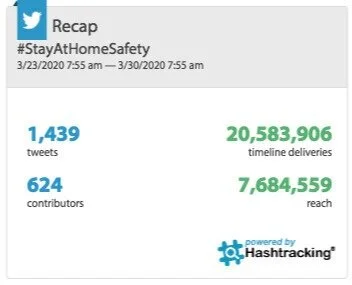
Last week, we hosted a Twitter chat about keeping kids safe at home while quarantining using #StayAtHomeSafety. We want to thank all of you who spread the word and participated. We were thrilled to have so many people and organizations participate, and we had over 20 million timeline deliveries. We put together a document that has the questions from the chat with a few of the answers that chat participants provided. You can access it here.
Also, PIPER at Colorado University hosted a Twitter chat on April 1st about child abuse and maltreatment during social distancing and quarantine. If you are interested in learning more about this topic, search #SaferQuarantine on Twitter. (P.S. You don't have to have a Twitter account to follow along with the conversation!)
ARCHIVED
Have information that you think would be helpful for our members? Send newsletter submissions (and feedback!) to info@preventchildinjury.org.